




There is a dream called Euro 2032. The goal is clear and shared by several cities across the Italian “boot.” Between surprise entries, a few current certainties, and the risk of shocking exclusions, the race to host this long-awaited continental event remains wide open. Final selections will inevitably be limited due to the joint bid with Turkey. While cities like Rome, Milan, Turin, and Florence seem to have the upper hand, enchanting locations such as Naples, Bari, Palermo, and Cagliari could face hurdles along the way.
Rome and its three wonders
The Capital is the heart of Italy and will undoubtedly play its usual leading role in the continental showcase. Despite chronic structural flaws that hinder a perfect view of the pitch, the Stadio Olimpico remains a reliable venue and will continue to be so in 2032. However, the Eternal City could unveil two other futuristic options: the new AS Roma stadium in Pietralata and the recently presented project by Claudio Lotito’s SS Lazio to renovate the Stadio Flaminio.
While much has already been said about the Giallorossi’s long-pursued project, which now seems close to completion, the most surprising news—despite long-standing interest from the Biancocelesti leadership—concerns the city’s second historic arena. The Flaminio, named after the Roman neighborhood of the same name, has hosted various sporting events since 1959, primarily football and rugby, as well as numerous concerts.
When the Olimpico was temporarily closed for renovations ahead of Italia ’90, the Flaminio provided the backdrop for thrilling matches featuring both Roma and Lazio—not to mention the eras of Lodigiani and Atletico Roma in Serie C. Lotito is now getting serious, announcing a total investment of approximately €500 million to create a contemporary hub with a 50,000-seat capacity. The project has been officially entrusted to the Archea Associati firm, led by architect Casamonti, with special supervision from Pierluigi Nervi (grandson of the original designer).
Turin’s certainty: the jewel of the Allianz Stadium
In Piedmont, everything is ready. No obstacles, no critical issues, no anxieties. The Allianz Stadium in Turin will undoubtedly showcase its brilliance for Euro 2032. In fact, it is currently the only structure guaranteed to serve as a host venue for the tournament. Opened in 2011 on the site previously occupied by the “cold” Stadio delle Alpi, it boasts a total capacity of 41,689 seats under a rectangular roof. It is a stunning arena, even internally, capable of hosting various events such as the SFS25 last November. As the home of Juventus, it also hosted the 2014 Europa League final between Sevilla and Benfica.
The Bianconeri’s proprietary project slowly began to take shape as far back as 1994. After long periods marked by bureaucratic, financial, and institutional hurdles, construction finally broke ground in 2009. Today, the Allianz Stadium is a comfortable facility with a strong focus on ecological sustainability. Furthermore, the stadium is just a stone’s throw from the Continassa Training Center and J-Medical, making it a perfect logistical hub for the national teams arriving in the Piedmontese capital.
The new San Siro: strength in unity
The situation surrounding the “Scala of Football” in Lombardy has turned into a complex dispute. Fortunately, in recent months, significant progress has been made, with Inter and AC Milan expressing their willingness to tackle this architectural feat by joining forces. Confirming these intentions, AC Milan President Scaroni spoke clearly at the “Your Next Milano 2026” event: “We will build the most beautiful stadium in Europe. Currently, the San Siro area is hell during matchdays and a wasteland when there isn’t a game. We want to make the green area accessible year-round, featuring restaurants, meeting places, bars, and sports activities—the area will do the city proud. The stadium represents about 20% of our revenue. With a new facility, without raising ticket prices but simply through additional activities, we expect to double that.”
The first interventions are set to begin next May, focusing on parking areas, relocating turnstiles, and gate adjustments. The “Diavolo-Biscione” partnership (Milan and Inter) is destined to write a new chapter in Milanese and Italian football history in the name of innovation.
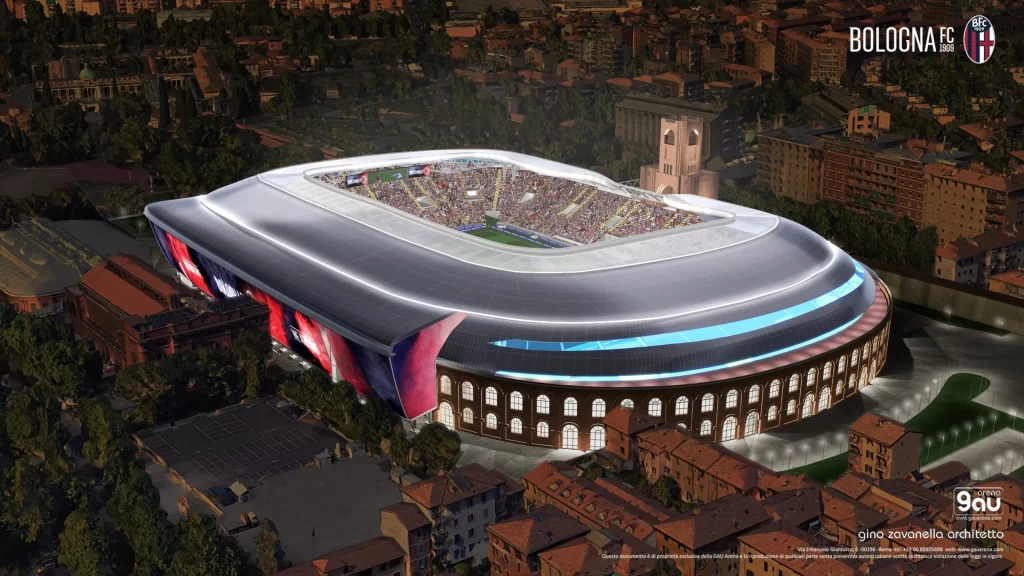
The uncertainty of Bologna’s Dall’Ara
The home of Bologna FC 1909 stands in the heart of the Porto-Saragozza district, just over 3 kilometers from the city center, and currently boasts a capacity of 36,532 seats. Built during the Fascist era and inaugurated in 1927 as the Stadio Littoriale, it exudes unmistakable historical charm while simultaneously showing the cracks of an obsolete structure. The first stone was laid by the official Leandro Arpinati, with the design executed by engineer Costanzini and architect Ulisse Arata. These names are significant, as the infrastructural nature of the work has remained almost intact through the ages. Italy vs. Spain was the first match played on this pitch.
Over the years, redevelopment efforts have been made, most notably for Italia ’90. This provided the opportunity to modernize the stadium with a new roof for the central and lateral stands, a complete overhaul of the lighting system, additional seating, and new safety exits. The athletics track was also refurbished—a popular feature at the time. In 2020, the club’s leadership officially submitted a restyling project to the Municipality of Bologna, which is still awaiting implementation. The goal is to provide full coverage for the stands and bring the seating closer to the pitch while preserving the symbolic Maratona Tower located opposite the main stand.
The “cooling” track of Bari’s San Nicola
The “Spaceship” is a creation of the 1990 World Cup. This massive facility, designed by global starchitect Renzo Piano, has a capacity of over 58,000. Originally intended solely for football, CONI ordered the addition of an eight-lane athletics track. The result is two concentric rings with a symmetrical elliptical plan. To this day, one can notice the unique international feature of the upper tier: 26 distinct sectors separated by 8-meter gaps.
Upon completion, the total cost reached a staggering 120 billion lire. Named after the city’s patron saint, it hosted the World Cup third-place play-off between Italy and England, the European Cup final between Red Star Belgrade and Marseille, and the 1997 Mediterranean Games. After wind damage to the roof in 2009, significant renovations didn’t return until 2020, when the local government began replacing all seats and upgrading the pitch with a modern irrigation system. Despite these upgrades, including a new press gallery and lighting for Euro 2032 standards, the “track” toward the tournament seems to be cooling due to a lack of private initiative and institutional drive.
Great expectations for Barbera 2.0
Palermo’s iconic stadium opened in 1932 within the scenic Favorita Park. Designed by architect Giovan Battista Santangelo, its skeletal structure remains largely unchanged since its inception, despite renovations for the 1990 World Cup. A significant intervention occurred in 1948, when the athletics track was removed to build the two “Curva” ends.
In 1988, a restyling costing 25 billion lire was tragically marred by the death of five workers due to a structural collapse. In 2002, the stadium was officially named in memory of Renzo Barbera, the beloved club president from 1970 to 1980. Recent years have seen the installation of a new 2,500-seat away sector and external facade embellishments by local street artists. The current capacity stands at 36,215.
The Municipality-De Laurentiis Dispute over the New Maradona
The situation in Naples is a case study in itself. The debate over the current location for Azzurri home games is wide open. Recently, the Municipality presented a project to the FIGC for the renovation of the Fuorigrotta facility. It is an ambitious plan: removing the athletics track, building a third tier, and expanding parking. However, Mayor Manfredi’s initiative faces opposition from Napoli owner Aurelio De Laurentiis, who dreams of a privately-owned stadium, potentially in a different area.
The old Stadio San Paolo has shown visible obsolescence for decades. Built between the 1940s and 50s and inaugurated in 1959, its original capacity (without a roof) was 85,012. The most impactful renovation occurred for the 1990 World Cup, which added a full roof but decreased spectator capacity. Since the 2005-2006 season, the third tier has been closed for safety reasons. Following a restyling for the 2018 Universiade, which introduced comfortable, sea-colored seating, the current capacity stands at 54,732.
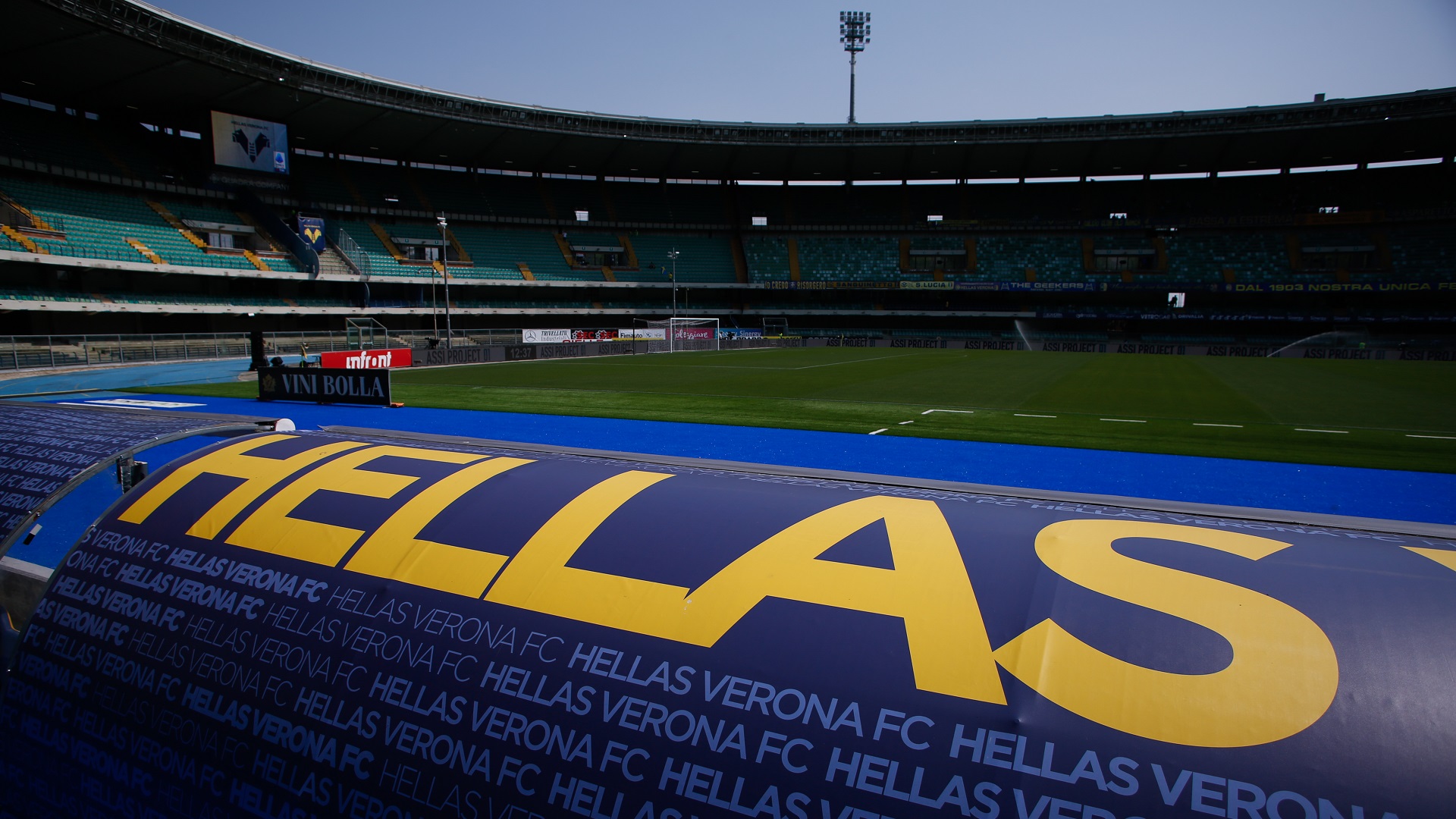
Verona’s project for the new Bentegodi
In the city of Romeo and Juliet and the iconic Arena, the Marcantonio Bentegodi has stood since 1963. This elliptical, oval-shaped facility currently has a capacity of 31,045 seats across three fully covered tiers, though only a portion is currently accessible. The stadium, located in the Piazzale Olimpia area, received its full roofing for the Italia ’90 World Cup. The first match played here dates back to December 15, 1963, a Serie B clash between Verona and Venezia.
The new Gialloblù ownership has launched an operation to provide the city with a brand-new facility. As stated in an official note released in recent months: “Hellas Verona FC is pleased to announce that it has initiated the process for the development of a new stadium on the site of the Marcantonio Bentegodi. The Club, together with HV1903, LLC—a wholly-owned subsidiary established to explore development opportunities—has submitted the project’s feasibility status to the technical offices of the Municipality of Verona. This is the first step in a long process involving the Club, its owner Presidio Investors, city administration representatives, and the Government”.
The Ambitions of Cagliari and Salerno
Also vying for a potential spot on the Euro 2032 host city list are the surprising Salerno and Cagliari. Salerno holds a strategic advantage, as the restyling process for the Arechi Stadium is already underway, starting with the demolition and subsequent reconstruction of the North Stand (Curva Nord). The new Arechi is expected to reach a capacity of 30,000 spectators.
Then there is Cagliari. On December 18, 2025, the Sardinian club officially announced the presentation of its economic and financial plan. With the neutral and independent supervision of Unicredit, the club has provided the necessary guarantees to demonstrate the project’s financial consistency. The new stadium, with a capacity of 25,000 (expandable to 30,000), will be named in memory of the legendary Gigi Riva and will be built on the site of the former Sant’Elia, near the current Unipol Domus.
The initiative is promoted through project financing, involving private capital, bank debt, and institutional contributions. The public sector is expected to provide a contribution of €50 million.
Euro 2032: The Origin and Structural Evolution of Italian Stadiums Vying to Host the Tournament
There is a dream called Euro 2032. The goal is clear and shared by several cities across the Italian "boot." Between surprise entries, a few current certainties, and the risk of shocking exclusions, the race to host this long-awaited continental event remains wide open. Final selections will inevitably be limited due to the joint bid with Turkey. While cities like Rome, Milan, Turin, and Florence seem to have the upper hand, enchanting locations such as Naples, Bari, Palermo, and Cagliari