





Beyond Visibility: how sports sponsorships generate business
For years, their value was measured using traditional metrics like Gross Advertising Value (GAV), based on the quantity of exposure: how many people see the logo and for how long. Today, this approach is no longer sufficient. Sponsorships are not mere advertisements (or ‘spots’): their impact depends on the quality of the exposure and fan perception. To demonstrate the true ROI, an integrated model is needed that combines visual data, brand insights, and purchasing behavior. In this article, we analyze how YouGov, through BIS, Brand Lift, and Shopper Intelligence, is redefining the measurement of sponsorships, transforming it into a strategic lever for business. We discussed this with Nicola Dimatteo, Senior Sales Executive at YouGov.
Why traditional sponsorship evaluation methods are no longer enough?
“Traditional methods, such as calculating Gross Advertising Value (GAV), focus on the quantity of exposure: how long a logo is visible and how many people see it. However, this approach only tells part of the story. Sponsorships don’t work like classic ads: they can be passive, fleeting, or remembered in different ways. To understand the real impact, it’s necessary to integrate the quality of exposure (BIS) and fan perception (Brand Lift & Shopper). YouGov offers a model that combines these two aspects, creating a more realistic and useful measurement to demonstrate ROI”.
What factors make up BIS and why are they important?
“BIS is based on five key elements:
- Solus: the logo appears alone, without other brands.
- Screen position: center is better than edges.
- Logo size: bigger means more visible.
- Exposure duration: more time, more impact.
- Frequency of appearances: repetition strengthens recall”.
These factors help understand not only how often the brand is seen, but how well it is seen.
3. Where do Brand Lift and Shopper Intelligence fit in the funnel?
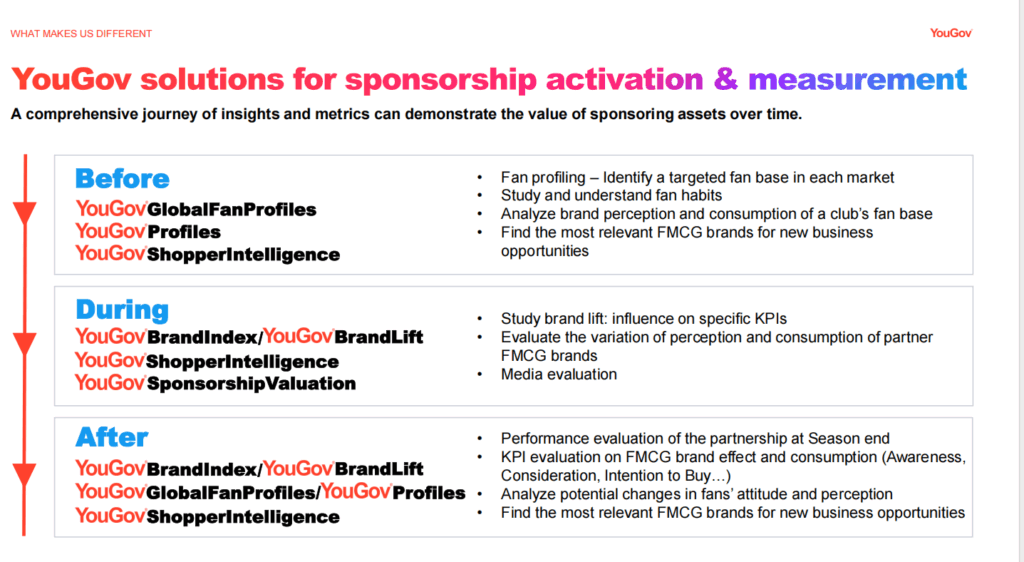
“Brand Lift covers all stages of the funnel: before the event, it leverages data to identify potential prospects, while during and after it measures the impact of activations on fan consumers. It relies on respondents’ statements to analyze how brand perception evolves over time, monitoring key indicators such as reputation, perceived quality, buzz, and purchase intent. This makes it the strategic bridge between visibility and consideration.
Shopper Intelligence instead acts at the end of the funnel, linking sponsorship to real behaviors: brand preferences, product choices, and conversions. We don’t stop at “how much was seen,” we go to “how much was sold.
We are the only ones offering this integrated solution, combining quantitative measurement, perception, and shopper data in a single ecosystem”.
4. What are the best practices to maximize sponsorship value?
- “Don’t stop at visibility: true ROI is measured by commercial impact.
- Optimize logo placement: centered and clean beats large but marginal.
- Leverage the sports context: some sports offer longer and more memorable exposures.
- Monitor brand health and purchase intent: before, during, and after the event.
- Benchmark against competitors: understand who converts better, not just who is more visible.
- Integrate all channels: TV, streaming, social, print, and retail”.
5. What is the future of sports sponsorships in the data era?
“The future lies in integrating visibility, perception, and purchase intent. It’s not enough to know how many people see a logo: brands want to understand if that exposure generates real engagement and sales. Technologies like BIS, Brand Lift, and our exclusive Shopper Intelligence allow sponsorships to be tied directly to business, turning marketing into a measurable lever. In the coming years, those who can leverage fan data to create personalized experiences and targeted campaigns will gain a huge competitive advantage”.

