




This article will answer the following three key questions: how much additional revenue could the new stadium generate, what level of investment will it require, and does it truly make sense for the two clubs to continue sharing a home?
On 30 September 2025, the Milan City Council approved the sale of San Siro and its surrounding land to AC Milan and FC Internazionale, clearing the way for the stadium’s demolition and the construction of a new, shared home for the two clubs. The decision marks a turning point in a saga that has spanned years and could reshape the financial and sporting outlook of both teams, as well as Italian football more broadly.
The recent council approval of the sale, valued at €197m, reignites the original vision: a brand-new, shared, state-of-the-art stadium designed to the highest standards of innovation, comfort, and sustainability. After years of false starts and consideration of alternative sites, the project finally appears to be on a clear path forward, with the two clubs having already appointed Foster + Partners and MANICA to design the new venue.
Italian clubs have long fallen behind their European counterparts in terms of infrastructure. Juventus FC is the only top club with a modern, wholly owned stadium, the Allianz Stadium, which was inaugurated in 2011. Across Europe, leading clubs have invested heavily in new or refurbished grounds, recognising the critical role of stadium infrastructure in financial sustainability and competitiveness. Tottenham Hotspur and Real Madrid have already demonstrated the transformative impact of their new stadiums, while Barcelona’s Camp Nou redevelopment is due for completion in 2026. In England, Everton have just moved into a new home, Manchester United are planning a 100,000-seat rebuild of Old Trafford, and Liverpool, Newcastle and Arsenal are all exploring expansion projects.
Milan’s new stadium project represents a pivotal opportunity not only for the clubs but for Italian football as a whole. Beyond the pitch, it promises major socio-economic benefits for the city, from urban regeneration and job creation to the establishment of a new landmark capable of attracting global visitors, as seen in cities like London, Manchester, Barcelona, and Madrid. A modern venue would also enhance Milan’s reputation, enabling it to host major events such as Euro 2032 matches and avoiding missed opportunities like the 2027 UEFA Champions League final being moved to Madrid due to San Siro’s shortcomings.
Within this context, in the following paragraphs, we will analyse three fundamental questions in relation to the new stadium project: what potential revenue upside could the clubs expect, how much will the new stadium cost, and why does sharing still make strategic sense?
What potential revenue upside could the clubs expect?
For AC Milan and FC Inter, the starting point is clear: despite strong fan demand, both clubs remain far behind Europe’s elite in matchday income. In the 2023/24 season, they ranked 12th and 14th, respectively.
At the top of the list, Real Madrid, which, thanks to the revamped Santiago Bernabéu, generated a record €250.7m in matchday income. This figure is expected to grow further in the coming years as the new stadium is fully leveraged on both matchdays and non-matchdays. Despite strong ticketing revenue growth in recent years, the combined stadium income of the Rossoneri (€82.3m) and the Nerazzurri (€74.7m) remains roughly €100m below Real Madrid and is also lower than Paris Saint-Germain (€170.1m) and Manchester United (€159.6m). Crucially, this shortfall compared to other top clubs is not due to poor attendance: in the post-COVID era both clubs consistently attract more than 70,000 fans per game, among the highest averages in Europe. The gap lies in San Siro’s outdated infrastructure, which offers limited scope for premium hospitality, commercial activities, and non-matchday events, all essential pillars of modern football economics.
RevPEPAS (revenue per event per available seat) provides a sharper lens. FC Inter (€41) and AC Milan (€40.2) sit only 18th and 19th in Europe. By contrast, PSG (€136.5) and Real Madrid (€123.7) achieved more than three times as much per seat. Even Juventus, at their peak in 2018/19 with Cristiano Ronaldo, achieved €72.7. The comparison highlights the structural disadvantage faced by the Milanese clubs under the current set-up.
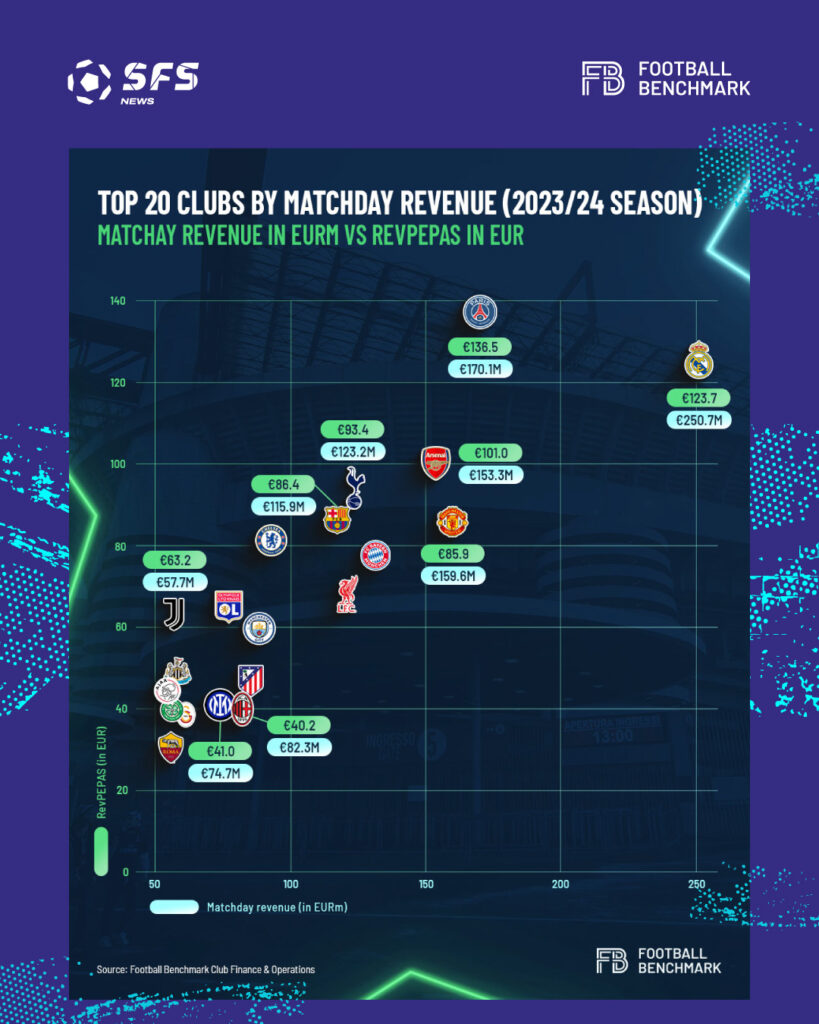
A modern venue would allow both clubs to narrow the gap with Europe’s elite teams. If utilised effectively, it could create a positive cycle for both sporting and commercial success. Corporate hospitality and events will present significant revenue opportunities in a city like Milan, situated in one of Europe’s wealthiest regions.
Benchmarks suggest both clubs could realistically target a RevPEPAS of at least €80, at current values. Given the planned capacity exceeding 70,000 and an assumption of 27 home matches per season, this would equate to more than €150m in annual matchday income per club, effectively doubling current levels. When factoring in naming rights, stadium tours, museums and corporate events, the incremental upside could reach at least €100m per season per club.
How much will the new stadium cost?
According to the preliminary documentation provided by the clubs to Milan’s municipality, key details about the new stadium concept have been revealed. The stadium will have a capacity of 71,500 seats arranged over two tiers, in contrast to the current three tiers at San Siro. Neither the roof nor the pitch will be retractable. In addition, the project will feature commercial areas, office spaces, a hotel, parking facilities, and the clubs’ museum and stores. These elements will significantly influence the overall capital expenditures.
While construction costs vary widely depending on factors such as size, location, design quality, infrastructure, technical specifications, and choice of materials, benchmarking against recently completed projects provides a useful baseline for estimating the investment required. For this analysis, we looked at a sample of eight stadiums built since 2015, each with a capacity of more than 50,000. All figures are drawn from publicly available sources and, where available, exclude land acquisition and investment in external infrastructure.
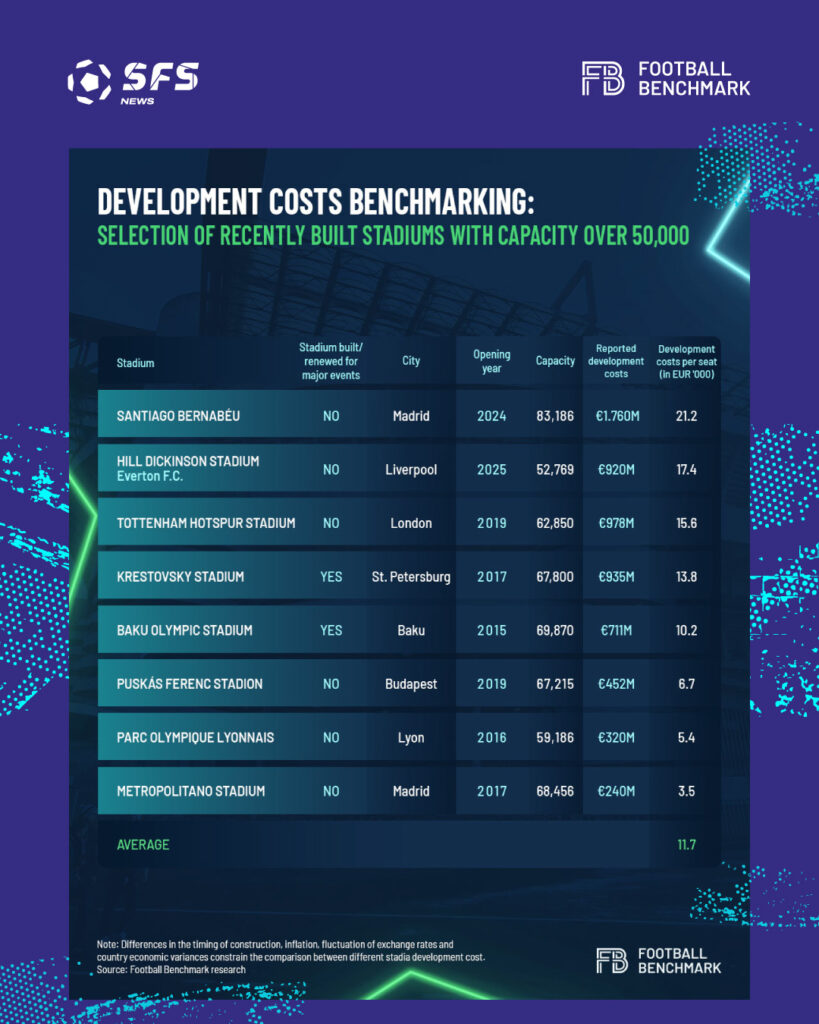
The most expensive project by far is Real Madrid’s Santiago Bernabéu, at more than €1.7bn or over €21,000 per seat. Everton’s new ground (€17,400) and Tottenham Hotspur Stadium (€15,600 per seat) also sit at the upper end of the range, while Lyon’s Parc Olympique (€5,400) and Atlético Madrid’s Metropolitano (€3,500) represent the most cost-efficient examples.
Across the sample, the average, excluding inflationary effects, was around €11,700 per seat. With global construction costs having escalated since the pandemic, it is unlikely that the new stadium could be delivered for less than €15,000 per seat. This points to a total investment of over €1bn, ultimately dependent on the degree of multifunctionality, the quality standards adopted, and the distinctiveness of its architectural design.
Why does sharing still make strategic sense?
AC Milan and FC Inter have cohabited San Siro for decades, operating as tenants only. Jointly building and owning a new, purpose-built venue is a very different challenge, with benefits and risks that merit careful consideration.
Firstly, it is fundamental to understand whether the sharing option is feasible. In terms of attendance, matchday revenues, fan base size and sporting performance AC Milan and FC Inter are remarkably similar, something which plays in favour of pursuing a shared home option.
In other European top leagues, it is uncommon for clubs to play in shared stadiums. The case of London is probably the most emblematic: in the 2025/26 season, there are seven clubs from the city and nearby suburbs competing in the English Premier League, each one with their own stadium. Even among clubs of comparable stature, a shared venue has never been seriously contemplated. In other cities, such as Madrid or Barcelona, the gulf between the local giants and their rivals makes cohabitation unworkable.
While many reasons could lie behind such an approach, tradition and socio-cultural aspects play a crucial role in this regard. Unlike in England, the Nerazzurri and Rossoneri have long been accustomed to sharing not only a stadium but, to some extent, the city’s footballing identity. The shared stadium has become a symbol of their rivalry and of the city of Milan itself, recognized worldwide. This socio-cultural acceptance gives the shared model unique legitimacy.
The financial rationale is clear. Sharing a stadium would generate major economic benefits for both clubs, a particularly relevant factor given their recent financial recoveries. AC Milan recorded their first net profit in 17 years in 2022/23, while FC Inter followed in 2024/25 after 15 years of losses. At the same time, the wider Italian football industry has struggled to grow media revenues, making the income potential of a state-of-the-art stadium increasingly vital for top clubs to remain competitive.
Primarily, by splitting development costs, the capital burden on each club would be significantly reduced. The same applies to ongoing maintenance and operating expenses, which are often underestimated but represent a considerable long-term saving when shared. Crucially, this model would not affect matchday earnings: ticketing and hospitality revenues would continue to be retained independently by each club, ensuring that income streams from their respective games remain intact.
Risks remain and would need to be carefully managed. Logistically, coordination can be challenging, as shown in 2022 when AC Milan were unable to celebrate their Scudetto triumph at San Siro because Inter were hosting their final league fixture. Future scheduling, pitch maintenance, and access for commercial or media events would require a well-defined operational framework.
Brand identity can present a challenge. A shared stadium inherently limits each club’s ability to fully customise the venue. While technologies such as adaptive lighting and digital branding can mitigate this, some compromises are inevitable. That said, the “neutrality” of the stadium could actually become a strength, positioning it as a year-round entertainment hub that appeals to broader audiences beyond football.
On the financial side, potential downsides include the additional costs of continuous redressing of the stadium for alternating tenants and the need to share revenues from non-football events such as concerts, conferences, corporate events and stadium tours. Potentially, joint ownership could also complicate sponsorship strategies.
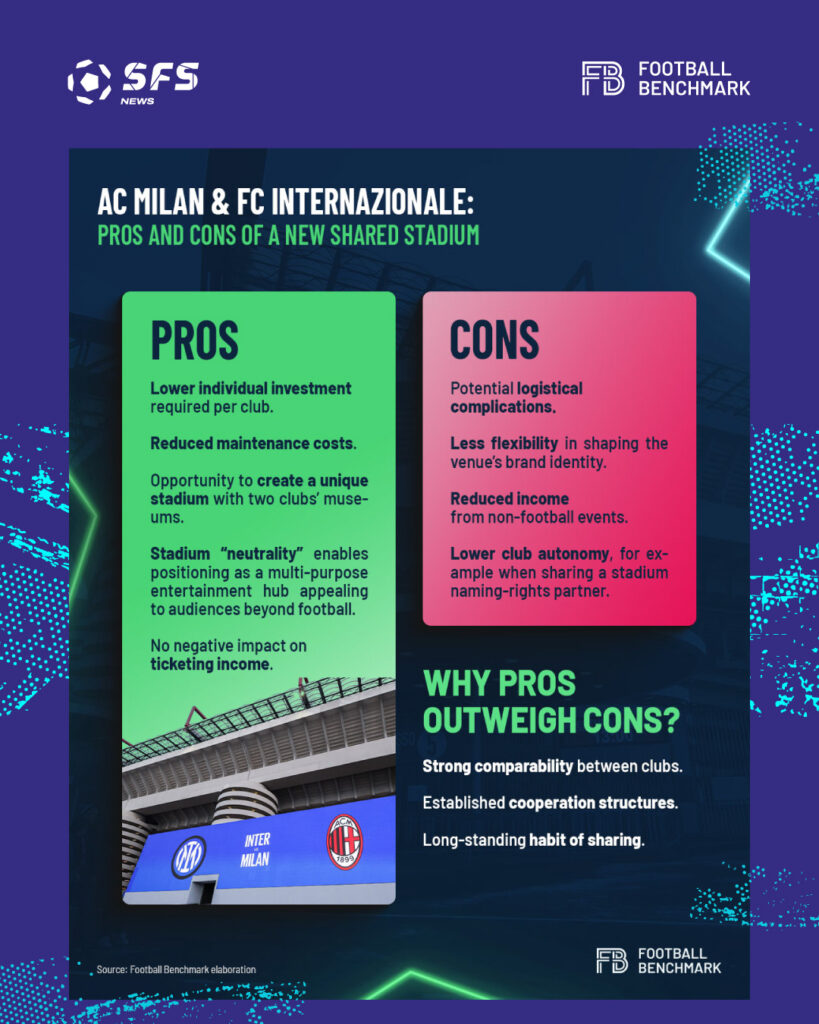
On balance, we believe that the benefits of a shared stadium for two clubs such as AC Milan and FC Inter far outweigh the drawbacks. Importantly, despite their fierce rivalry, both organisations and their supporters have demonstrated for more than 70 years their ability to coexist in the same venue, making the shared model both more financially sustainable and strategically sound.
Shared challenges, greater rewards
The outlook for Milan’s new stadium is clear: it offers substantial revenue potential for both clubs, represents an investment exceeding €1bn, and, given their shared history and similarities, a joint approach may prove the most strategic and viable path forward.
After years of delays, Milan’s stadium project is finally moving towards reality. If delivered, the impact will be transformative: a modern venue in one of Europe’s wealthiest regions could generate well over €100m in additional annual revenues per club. With construction costs likely to exceed €15,000 per seat, the total investment is estimated to surpass €1bn, but the long-term returns are likely to justify the scale.
For AC Milan and FC Inter, continuing to share a stadium is less about rivalry than pragmatism. Splitting development and operating costs strengthens the business case, while the city’s unique football culture gives the model rare legitimacy. Some challenges remain, but the benefits outweigh the risks.
In the long term, a shared home has the potential not only to enhance the competitiveness of both clubs but deliver broader economic and cultural rewards for the city. Indeed, a venue housing two mega-club museums would be a landmark tourist attraction in its own right, reinforcing Milan’s global profile.
At Football Benchmark, we support clubs and investors in stadium feasibility, conceptualisation, and business optimisation, helping them evaluate opportunities, plan long-term strategies and maximise the value of both new infrastructure projects and existing venues
By Football Benchmark
Milan’s new stadium: Revenue potential, investment requirements, and the case for sharing
This article will answer the following three key questions: how much additional revenue could the new stadium generate, what level of investment will it require, and does it truly make sense for the two clubs to continue sharing a home? On 30 September 2025, the Milan City Council approved the sale of San Siro and its surrounding land to AC Milan and FC Internazionale, clearing the way for the stadium’s demolition and the construction of a new, shared home for the

YouGov confirmed as Partner of the 8th Edition of the SFS
The SFS is proud to announce that YouGov will once again be Partner of the 8th edition, taking place on November 18–19, 2025 at Allianz Stadium, Turin. YouGov, a global leader in data analytics and market research, has been an integral part of the Summit’s journey, contributing valuable insights on fan engagement, sponsorship evaluation, and market trends in football. YouGov’s proprietary panel of over 24 million respondents across 59 markets allows for a unique, data-driven understanding of how football evolves globally, and works across sectors such as media, sports, and consumer behavior helps clubs,
ADVANT joins SFS 25 as Main Partner
The Social Football Summit is proud to announce ADVANT as Main Partner of its 8th edition, taking place on November 18–19, 2025 at the Allianz Stadium in Turin. ADVANT is a Consulting and System Integration company providing high-value professional services in Information Technology. With offices in Rome and Milan, the company is structured into centres of excellence that guide clients through every stage of digital transformation — from design to development, implementation, maintenance, project management, and training. Thanks to its strong expertise in: Data & AI: design and implementation of advanced Business & Artificial Intelligence systems across

From Allianz Stadium to the Football Industry: an unmissable opportunity. Join the team!
If your goal is to work in the world of soccer, SFS 25 represents a great opportunity. It's not just about participating as a volunteer, but about gaining access to the “behind the scenes” of one of the leading international events dedicated to the Football Industry, to be held in Turin on November 18 and 19 at the Allianz Stadium. For years, SFS has brought together experts, executives, innovators, and stakeholders from the global football industry. Being part of the volunteer

SFS EXTRATIME returns: the innovation tour heads to Turin, Rome, and Caserta on the road to SFS 25
SFS EXTRATIME, the Startup Competition of SFS 25, is back in collaboration with Almaviva, with a new Innovation Tour across three Italian cities – Turin, Rome, and Caserta – to discover the most groundbreaking projects capable of revolutionizing the future of the Football Industry and the wider sports business. The Innovation Tour offers a unique opportunity for startups, students, innovators, and young entrepreneurs to explore the world of SFS EXTRATIME and learn how to submit their ideas. Here’s the full schedule: - Turin – October 9, 2025, 2:00 PMUniversity of Turin, Luigi Einaudi

Enovation Consulting renews its partnership with SFS
We are thrilled to announce that Enovation Consulting has renewed its strategic partnership with SFS! The eighth edition of SFS will take place on November 18–19 at the Allianz Stadium in Turin and will be an opportunity to delve into key topics such as innovation, sustainability, and business development in the world of football. Together with Enovation Consulting, we will explore how clubs, leagues, and industry stakeholders are integrating sustainable practices and innovative solutions to address the environmental and social challenges facing the sports sector in a more responsible way. This renewed collaboration marks an
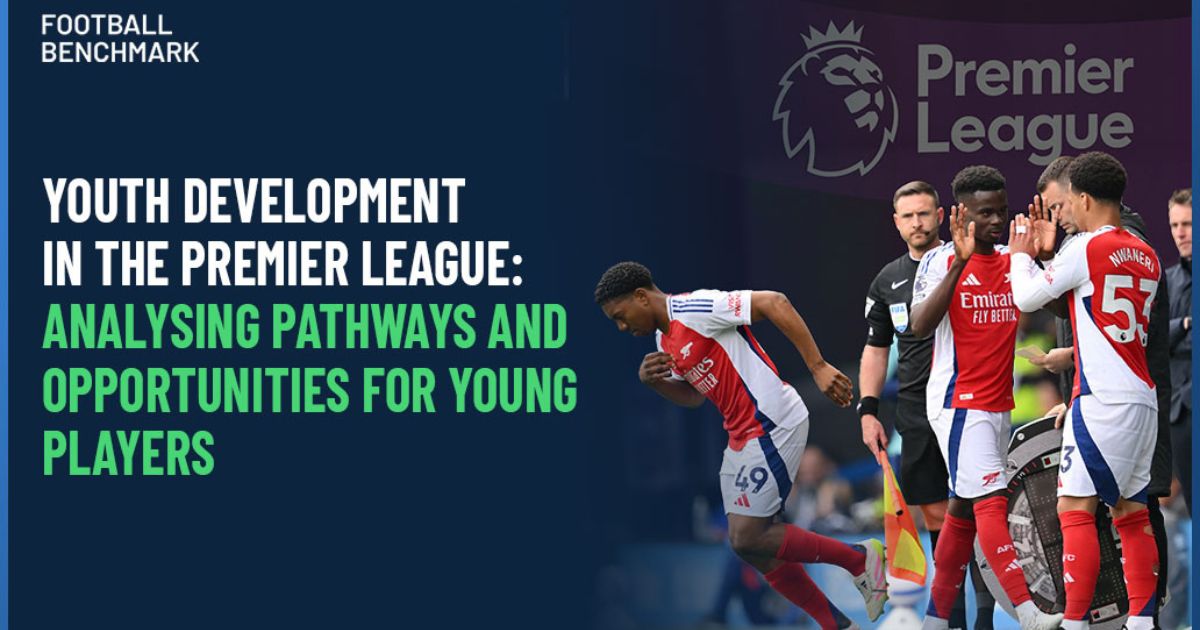
Youth development in the Premier League: Analysing pathways and opportunities for young players
Article written by Football Benchmark The Premier League is recognised worldwide as the most competitive and lucrative domestic competition. Alongside its record revenues, the league and English football more broadly have accelerated their progress in youth development in recent years. England’s U21 side secured its second successive UEFA U21 EURO title this summer, while players such as Liverpool’s Rio Ngumoha and Arsenal’s Max Dowman are making first-team debuts before turning 17. At the same time, at the highest level of
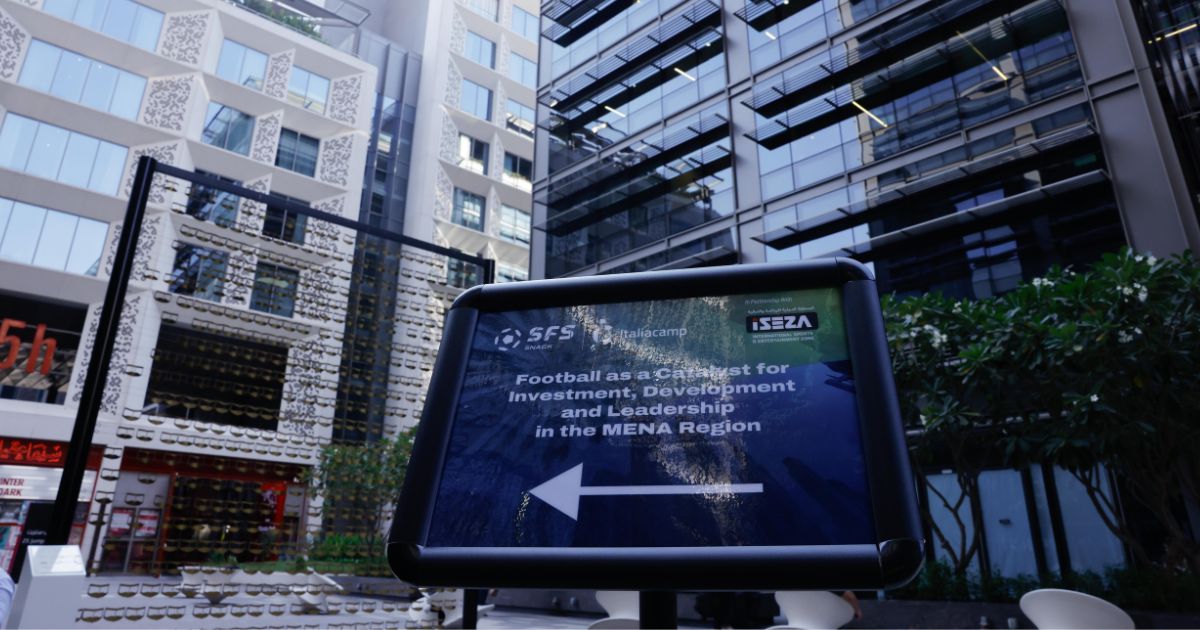
DUBAI HOSTS SUCCESSFUL EDITION OF SFS SNACK: FOOTBALL AS A DRIVER OF GROWTH AND LEADERSHIP IN MENA
Social Football Summit (SFS) and Italiacamp EMEA, in partnership with the International Sports & Entertainment Zone (ISEZA), successfully hosted SFS Snack Dubai on 29 September 2025, gathering institutions, leagues, clubs, companies, and football legends to discuss how football can act as a catalyst for investment, development and leadership across the MENA region. The conference, held at ISEZA – One Central, Dubai World Trade Centre, featured a rich agenda with panels on destination marketing, the growth of leagues, football’s challenges and opportunities, innovation in broadcasting, and inspiring leadership stories from
Lazio region and Camera di Commercio of Rome bring you to SFS 25 in Turin
The Rome Chamber of Commerce launches a strategic initiative to support the area's economy. With the support of the Special Company Development and Territory, and in collaboration with the Lazio Region (through Lazio Innova), the expression of interest is open for participation in the upcoming SFS25. The goal is to select and promote three regional excellences in the Football Industry. The Call: 3 Full Board Seats for Lazio Startups and MPMIsAs part of the Convention for Joint Participation in Trade Fair

Breaking into the Premier League’s “Big 6”: Are challengers changing the competitive landscape on and off the pitch?
Article written by Football Benchmark Over the past decade, the term “Big 6” has become central to discourse around the Premier League. Arsenal, Chelsea, Liverpool, Manchester City, Manchester United, and Tottenham Hotspur have been the sporting and financial powerhouses of a league that is itself the global leader in club football. These clubs have dominated domestic performance, secured the majority of Champions League places, and built global commercial brands. Yet the wider environment has shifted. The Premier League’s broadcast revenues have increased,