




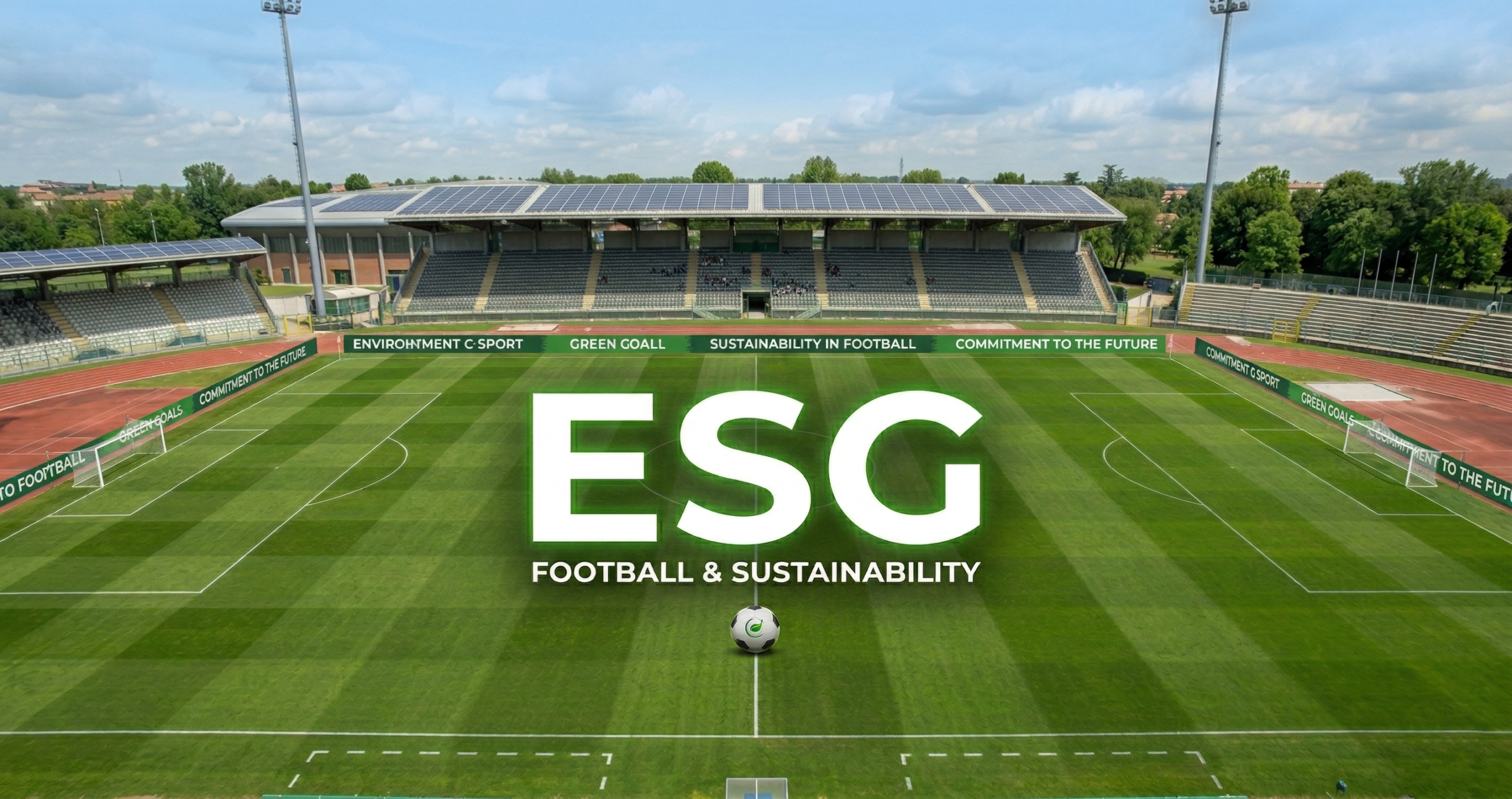
Why sustainability is becoming a competitive advantage for football clubs
When ESG is mentioned in football, the first reaction is often the same: it’s a topic for large multinationals, not for sports clubs. Or: it’s a matter of image, not business. Both positions are understandable, especially for those who haven’t yet had the chance to engage concretely with what is happening in the market. But the facts tell a different story—and it’s worth understanding it.
ESG stands for Environmental, Social, Governance. These are three dimensions that measure how sustainable an organization is: in its environmental impact, in its relationship with people, and in the quality of its internal management. In football, these three dimensions translate into concrete criteria that three key stakeholders—UEFA, global sponsors, and institutional investors—already use today to evaluate, select, and finance football clubs. Understanding how this mechanism works is the first step in turning sustainability from a perceived obligation into a concrete advantage.
What ESG criteria are and why they also concern football clubs
Before diving into the specific dynamics, it’s useful to clarify what ESG actually means when applied to a sports organization.
The environmental dimension—the “E”—concerns everything a club does, or does not do, in relation to its environmental impact. It’s not just about solar panels or recycling in the stadium. It involves measuring CO₂ emissions linked to sporting activities, from matches to travel; assessing the energy efficiency of facilities; and analyzing the sustainability of the supply chain, from kit production to catering services. It’s a much broader scope than commonly assumed, and it requires precise measurement tools.
The social dimension—the “S”—concerns a club’s relationship with people: employees, players, staff, fans, and the local community. It includes diversity, equitiy and inclusion (DEI) policies, social programs aimed at the local area, and the management of labor rights throughout the value chain. A club that generates measurable and documented social value builds a form of credibility that goes far beyond winning trophies.
The governance dimension—the “G”—concerns how a club is managed: transparency in decision-making processes, the composition and functioning of the board of directors, internal control mechanisms, conflict-of-interest management, and the quality of reporting to stakeholders. Strong governance is not just an ethical issue—it directly affects how a club is evaluated by investors and financial institutions.
These three dimensions are interconnected. Together, they shape an organization’s ESG profile—a profile that, in football in 2026, is actively assessed by specific stakeholders, with very tangible consequences.
What UEFA requires from football clubs on sustainability
UEFA has placed sustainability on its strategic agenda, with practical implications in its regulations. The Football Sustainability Regulations have introduced ESG criteria into the financial fair play framework, with direct consequences for licensing processes for European competitions.
In concrete terms, this means that to participate in European competitions—and to be positively evaluated by UEFA—clubs must demonstrate measurable and documented commitment to sustainability.
The key word here is “documented.” Good intentions are not enough. Posting a few green initiatives on social media is not enough. Having a charitable foundation is not enough. What’s required is a structured measurement system, reporting based on internationally recognized standards, and verifiable data. UEFA does not ask for statements—it asks for evidence.
For clubs with European ambitions, this is not something to delegate to the communications department. It is a core part of overall strategy, just like financial management and sporting planning. Importantly, UEFA’s sustainability requirements are not limited to clubs regularly competing in Europe—they are progressively extending across all levels of organized European football.
Why global sponsors assess a club’s ESG profile before signing
To understand why global sponsors look at ESG before signing a sponsorship deal, it’s necessary to consider the regulatory environment in which they operate.
The Corporate Sustainability Reporting Directive (CSRD) requires large companies—those exceeding certain employment and turnover thresholds—to report their ESG performance starting with 2027 data. These companies must therefore provide structured and verifiable sustainability disclosures, which changes how they evaluate the partners they publicly associate with.
This means that when a major sponsor evaluates a football sponsorship, it doesn’t just look at visibility, fan base, international presence, or brand strength. It also looks at the club’s ESG profile. Associating with a partner that lacks documented ESG credentials can negatively affect the sponsor’s reporting to investors and regulators, as well as expose the brand to reputational risk.
The practical outcome is that binding ESG clauses are now appearing in high-level sponsorship contracts. A club with a recognized ESG rating and an up-to-date sustainability report is, all else being equal, a more attractive partner. Not because sponsors are necessarily more environmentally conscious than before, but because such a club solves a compliance issue that sponsors would otherwise need to address themselves.
There is also an additional commercial dimension. Major sponsors are not just looking for compliant partners—they are looking for credible storytelling platforms. A club with a genuine and communicable ESG journey becomes a narrative vehicle through which a sponsor can reach millions of fans and demonstrate its values in practice. This kind of partnership goes beyond a logo on a shirt and translates into stronger renewals and larger budgets over time.
How institutional investors evaluate a football club
For those unfamiliar with institutional finance, it may seem surprising that an investment fund conducts ESG due diligence before acquiring a stake in a football club. In reality, this is exactly what should be expected.
The funds entering European football today are no different from those being invested in any other industry. They bring the same practices, the same obligations to their own investors, and the same risk assessment frameworks.
Large international funds operate within mandatory ESG frameworks imposed by their upstream investors—pension funds, insurance companies, and banking foundations managing vast amounts of capital and adopting strict ESG policies. Before investing in a club, these funds analyze its sustainability profile: good governance, environmental impact, and social policies. All these aspects are assessed and weighed in their final evaluation.
A club with structured ESG documentation presents a lower risk profile and greater transparency. In practical terms, this means higher valuation, better investment terms, and smoother negotiations. A club without ESG documentation, on the other hand, presents a less defined risk profile, leading to more cautious valuations—or, in the worst cases, deals that fall through.
The same principle applies to bank credit. European banks, in line with ECB guidance and EBA regulations, are progressively integrating ESG criteria into their risk assessment models. A club with a solid ESG rating can access credit on more favorable terms: better rates, faster approval processes, and stronger long-term relationships with the banking system. In a sector where liquidity management is often crucial, this difference has a real impact on year-end financial results.
Where to start: the ESG journey for a football club
The good news is that starting a structured ESG journey does not require a complete organizational overhaul overnight.
The starting point is measurement: understanding the current position, identifying strengths and areas for improvement, and determining the most relevant ESG risks for the specific organization. This phase is called a double materiality analysis: on one hand, assessing the club’s impact on the environment and society; on the other, analyzing how ESG factors affect the club’s business itself. This is the foundation for everything that follows.
Based on this analysis, a roadmap is defined with concrete objectives, measurable indicators, and realistic timelines. Reporting is initiated according to internationally recognized standards such as the Global Reporting Initiative (GRI) standards or the European Sustainability Reporting Standards (ESRS). Although sustainability reporting is mandatory only for large companies under CSRD, these standards are now the most credible reference point for medium-sized organizations seeking to build a solid and communicable ESG profile.
Over time, verifiable documentation is built for all relevant stakeholders: UEFA, sponsors, investors, banks, and the local community.
Today, technological tools make this process accessible even to mid-sized clubs—not just top-tier European teams with complex organizational structures. Technology enables automated data collection, integration with national and international regulations, and the production of verifiable reports within reasonable timeframes. What once required months of consultancy work can now be managed far more efficiently.
The key, as always, is to start. Because in football—as in business—those who build an advantage first tend to retain it longer. And in European football in 2026, sustainability is already a competitive advantage for those who have it—and a gap to close for everyone else.
This contribution was prepared by FDC Consulting D-ESG, a consulting firm that promotes a concrete, data-driven approach to sustainability, with the aim of turning it into a competitive advantage for organizations.
