




Article written by Football Benchmark
European club football has enjoyed strong revenue growth over the past decades, driven by expanding competitions, internationalisation, and commercial innovation. Yet recent years have tested this trajectory. The COVID-19 pandemic disrupted operations, while ongoing shifts in the media landscape continue to put pressure on historically reliable income streams. In parallel, regulatory frameworks have increasingly prioritised financial sustainability, reshaping the operating environment for clubs across the continent.
Despite rising revenues, there remains a widespread perception that football clubs are structurally loss-making organisations, with value creation stemming largely from asset appreciation rather than bottom-line profitability. Indeed, many clubs still operate at a loss.
This article examines audited financial data since the 2018/19 season to identify those European clubs that have demonstrated sustained profitability over multiple years. Their performance offers valuable lessons for the wider industry on what sustainable success can look like in practice.
The revenue giants
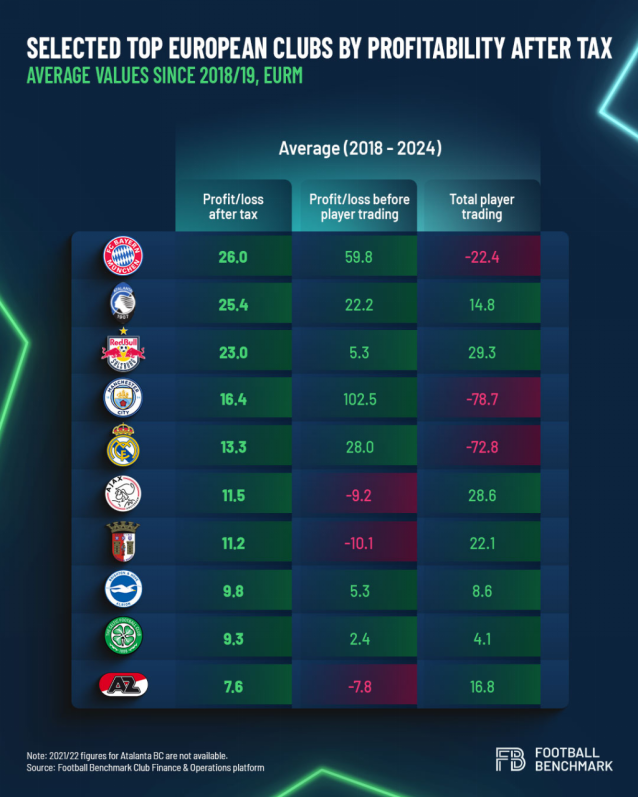
Commercial and sporting dominance continues to provide the clearest pathway to profitability. Among the most profitable European clubs over the past six seasons are FC Bayern München, Manchester City FC and Real Madrid CF — revenue giants whose scale sets them apart from the rest of the industry.
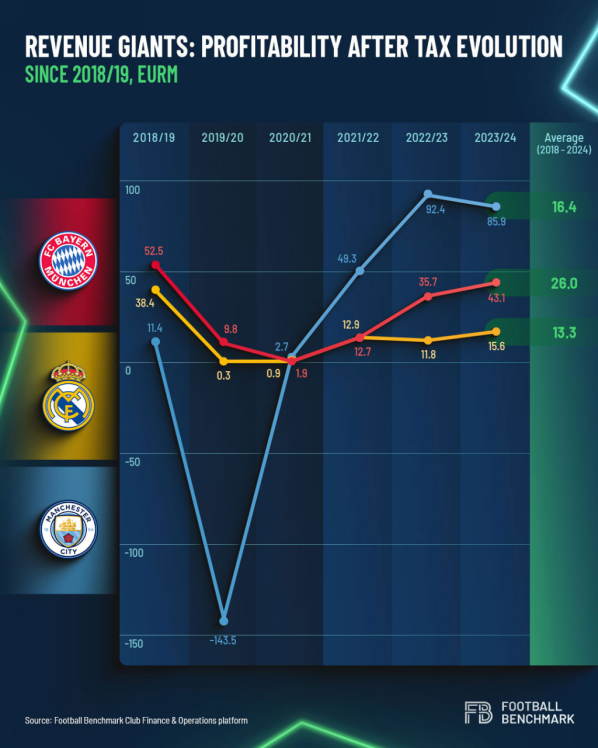
Their profiles share common features. Backed by exceptional commercial strength and international reach, they consistently generate some of the highest revenues in world football, supporting robust operating profitability before player trading (2018–2024 average: Bayern €59.8m, City €102.5m, Real Madrid €28.0m). Equally important, each has maintained cost discipline, with staff-cost-to-revenue ratios averaging 56%, 61% and 59% respectively since 2018/19 — all well below typically recommended thresholds. This balance between revenue scale and controlled expenditure underpins their sustained financial performance.
Bayern stand out for their long-term stability, reporting a profit for 32 consecutive years. Manchester City’s trajectory has been more volatile, though recent record-breaking results — peaking after their UEFA Champions League triumph — have offset a €143.5m loss in 2019/20. Real Madrid’s unmatched commercial capacity, becoming in 2023/24 the first club to surpass €1bn in annual operating revenue, enables continued investment in young talent and infrastructure while preserving profitability.
These cases illustrate how a combination of scale, global marketability, and financial discipline can secure consistent profitability, even with significant investment in elite squads. With additional revenues expected from UEFA’s revamped Champions League format and the expanded FIFA Club World Cup, the leading trio are well positioned to extend their advantage. Crucially, Bayern, City and Real Madrid’s ability to sustain sporting dominance has enabled them to operate from a position of strength, making measured financial decisions rather than reactive ones. By contrast, other revenue leaders have generated substantial income but struggled to achieve comparable profitability — underlining that scale, on its own, is not sufficient.
The domestic dominators
A model equally based on sporting domination, albeit at a different scale, is that of clubs operating as leaders in Europe’s mid-sized markets. Celtic FC in Scotland, RB Salzburg in Austria and, until recently, AFC Ajax in the Netherlands are typical examples. Their domestic strength has traditionally provided the foundation for long-term planning, with recurrent participation in UEFA competitions — often the Champions League — ensuring stable broadcasting and prize money. This recurring income has given such clubs the capacity to run profitable operations, at times even before player trading, with additional upside generated through regular surpluses on transfers.
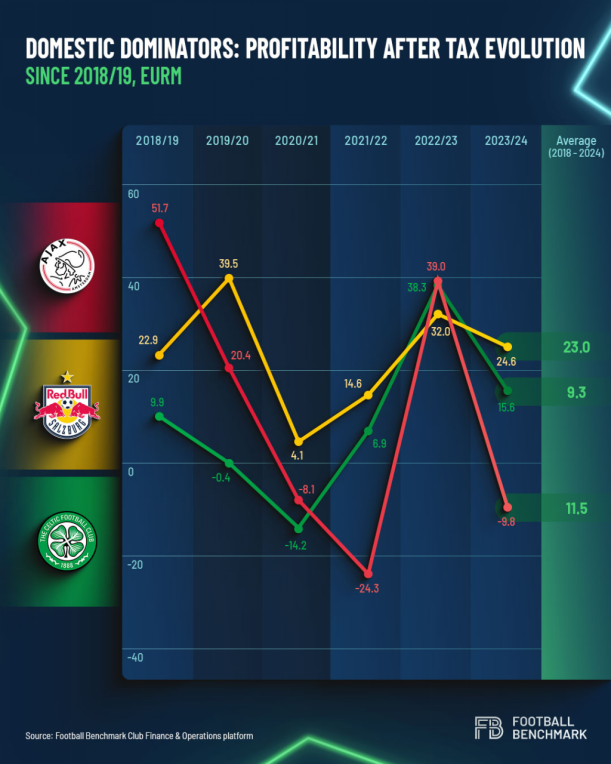
While their total player trading remains modest (average €4.1m), Celtic FC exemplify the model like few others. During the analysed period, the club recorded an average profit of €9.3m, thanks to the combination of stable revenues — most notably strong matchday income — disciplined cost control, and recurrent European participation.
RB Salzburg illustrate the model at its most effective. Over the period analysed, they delivered an average profit of €23.0m, supported by an average player trading of €29.3m. Even excluding transfers, the club remained profitable, with a staff-cost-to-revenue ratio averaging just 54% — reaching as low as 37% in 2023/24. Their combination of strong domestic dominance, steady European qualification and world-class scouting through the Red Bull network has produced one of Europe’s most consistent and financially sustainable operators.
AFC Ajax historically combined the strategic advantages of both Celtic and Salzburg: the scale and fan base of the former with the player development and trading expertise of the latter. This made them, for many years, the most complete example of the model. Ajax delivered an average profit of €11.5m in the period, supported by strong player trading surpluses from transfers including Matthijs de Ligt (€86m), Frenkie de Jong (€86m) and Antony (€95m). However, increasing competition at home from PSV and Feyenoord has eroded their domestic dominance, forcing greater reliance on trading at a time when results in that area have weakened — underlining the vulnerability of this model when domestic control is no longer guaranteed.
Taken together, these cases show how domestic dominance in mid-sized markets can provide a solid platform for profitability, combining recurrent European revenues with disciplined cost control and positive trading balances. The challenge, however, lies in maintaining that dominance. Once contested — as Ajax have experienced — the model becomes more fragile, forcing clubs to rely more heavily on trading to preserve profitability. At the same time, prolonged one-club dominance can reduce the commercial appeal of a domestic league, ultimately limiting growth opportunities for the dominant club itself.
Trading & performing
A third group of regularly profitable clubs can be defined by their excellence in player development, scouting and trading. Rather than relying primarily on revenue scale, these clubs have built sustainable models by identifying and developing talent, then generating significant returns through sales. While competing at the upper end of their domestic leagues and often qualifying for European competitions, their ambition is to challenge leaders in a financially controlled and strategic way.
In Europe’s major markets, Atalanta BC exemplify this model, recording an average profit of €25.4m (2018–2024) underpinned by a strong player trading surplus, including transfers such as Dejan Kulusevski (€44m) and Cristian Romero (€55m). Regular participation in UEFA competitions and disciplined cost management (average staff-cost-to-revenue ratio of 61%) have positioned the Italian club as one of Europe’s most efficient operators outside the very top revenue bracket.
In recent seasons, Brighton & Hove Albion FC have emerged as another benchmark for this model, with an average profitability of €9.8m during the analysed period. Thanks to smart squad building and trading — exemplified by Moisés Caicedo and Alexis Mac Allister — the Seagulls have combined extraordinary total player trading (2022/23: €101.9m; 2023/24: €79.3m) with growing media revenues from improved Premier League performances and UEFA competition appearances.
A similar approach is followed by certain clubs in mid-sized markets, where profitability is often even more reliant on trading income. Sporting Clube de Braga (average profit €11.2m) and AZ Alkmaar (average profit 7.6m) are clear examples, both consistently leveraging player trading to cover operating losses. The structural challenges of smaller revenue bases remain evident: in their efforts to remain competitive and regularly qualify for European competitions, both clubs operate with staff-cost-to-revenue ratios above recommended thresholds (Braga, 94%; AZ, 72%), highlighting the delicate balance they must maintain.
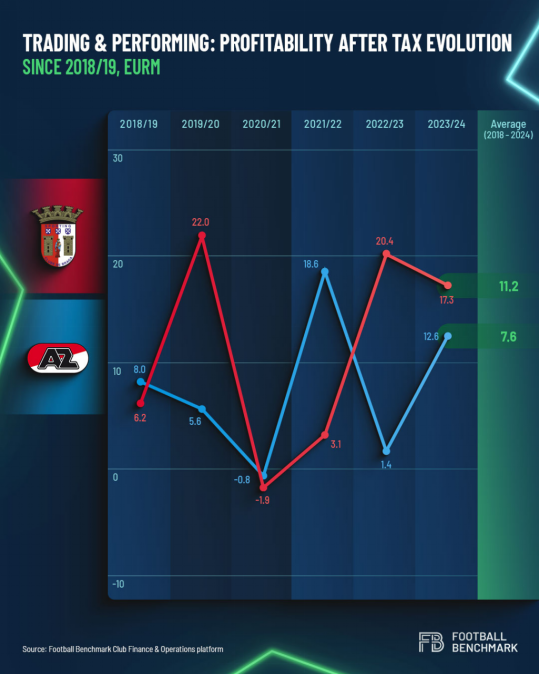
For clubs based in attractive leagues and markets, player trading can provide a viable pathway to profitability. However, this model carries inherent risks: a single season without European football combined with an underperforming transfer window — always a possibility in football — can quickly translate into significant losses.
The efficient operators
A final group of profitable clubs can be defined not by revenue scale or trading surpluses, but by their ability to run lean and cost-conscious operations. These clubs, often competing in the shadow of wealthier domestic rivals, achieve profitability by seeking to optimise spending as much as possible on and off the pitch — even when this comes with the risk of sporting underperformance or relegation.
This approach is particularly viable in leagues with strong media revenues, which provide even smaller clubs with the financial base to remain profitable when managed cautiously. Spain offers some of the clearest examples. Rayo Vallecano, back in UEFA competition this season for the first time in 24 years, recorded an average profit of €5.1m during the analysed period, despite spending two seasons in the Spanish second tier. Similarly, SD Eibar delivered recurrent profits during their extended LaLiga stint, only to fall into losses following their return to the second division in 2021.
These cases highlight both the possibilities and the vulnerabilities of this model: profitability is achievable through cost-conscious management at the top-flight level, but relegation remains an ever-present threat that can quickly undermine financial stability.
Balancing Ambition and Sustainability
Each pathway reflects specific structural advantages — whether scale, domestic dominance, talent development or efficiency — but all share two common denominators: disciplined cost management and the alignment of sporting ambition with financial reality.
It is equally important to note that while established clubs can sustain profitability within these models, the road to reaching that position often requires significant investment. Challenger clubs seeking to break into the elite, secure promotion, or consolidate themselves at the top level are frequently those that record the heaviest losses until they achieve stability.
Financial sustainability therefore depends on deliberate strategic choices tailored to context — market size, fan base, ownership appetite, and competitive environment. Risks remain —from over-reliance on trading, to the fragility of domestic dominance, to the ever-present threat of relegation — but the evidence demonstrates that profitability is attainable across very different types of clubs.
As football continues to adapt to shifting media dynamics, new competition formats and evolving regulatory frameworks, the ability to balance financial sustainability with sporting ambition will be more decisive than ever.
Football Benchmark works with clubs and investors to deliver data-driven financial planning and strategic guidance, helping owners design and execute the roadmaps needed to achieve their long-term ambitions.
By Football Benchmark
Profitability in football: Lessons from Europe’s most profitable clubs
Article written by Football Benchmark European club football has enjoyed strong revenue growth over the past decades, driven by expanding competitions, internationalisation, and commercial innovation. Yet recent years have tested this trajectory. The COVID-19 pandemic disrupted operations, while ongoing shifts in the media landscape continue to put pressure on historically reliable income streams. In parallel, regulatory frameworks have increasingly prioritised financial sustainability, reshaping the operating environment for clubs across the continent. Despite rising revenues, there remains a widespread perception that football
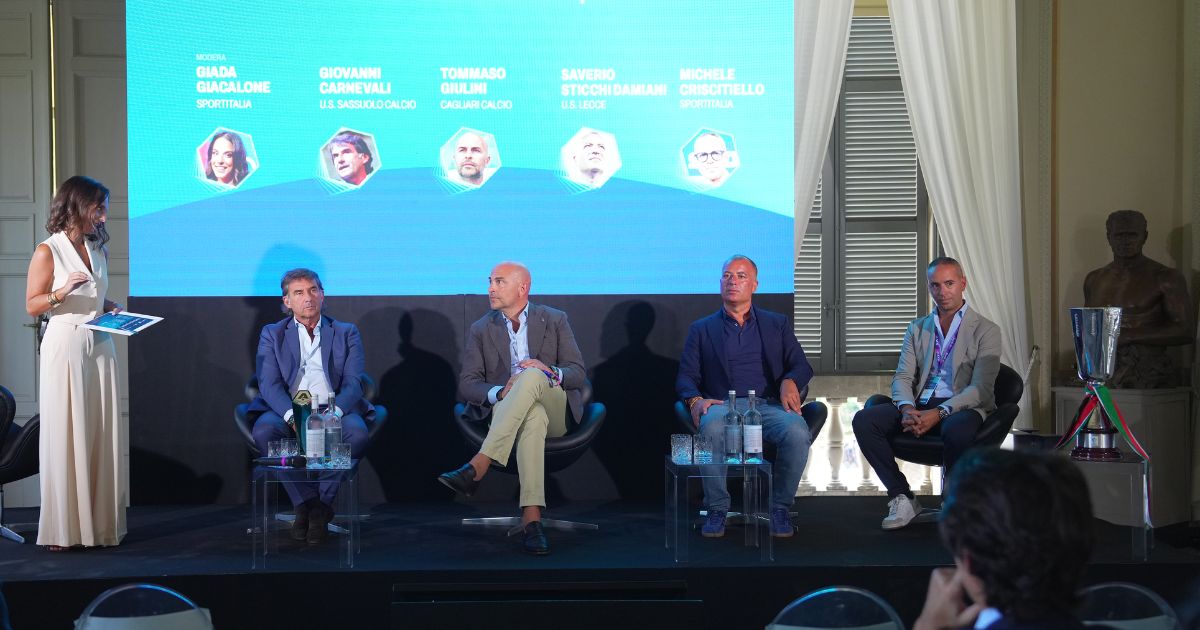
PLANNING AND STRATEGIES IN YOUTH CATEGORIES
The event, organized by SFS in collaboration with Lega Serie A and under the patronage of the City of Milan, was held on the occasion of the Inter-Cagliari Primavera Supercup Final In the picturesque setting of the Palazzina Appiani, inside the"Gianni Brera" Civic Arena in Milan, the first SFS Snack of the 2025/2026 season, entitled "Planning and Strategies in Youth Categories," was held today, promoted by SFS and Lega Serie A, under the patronage of the City of Milan, on the
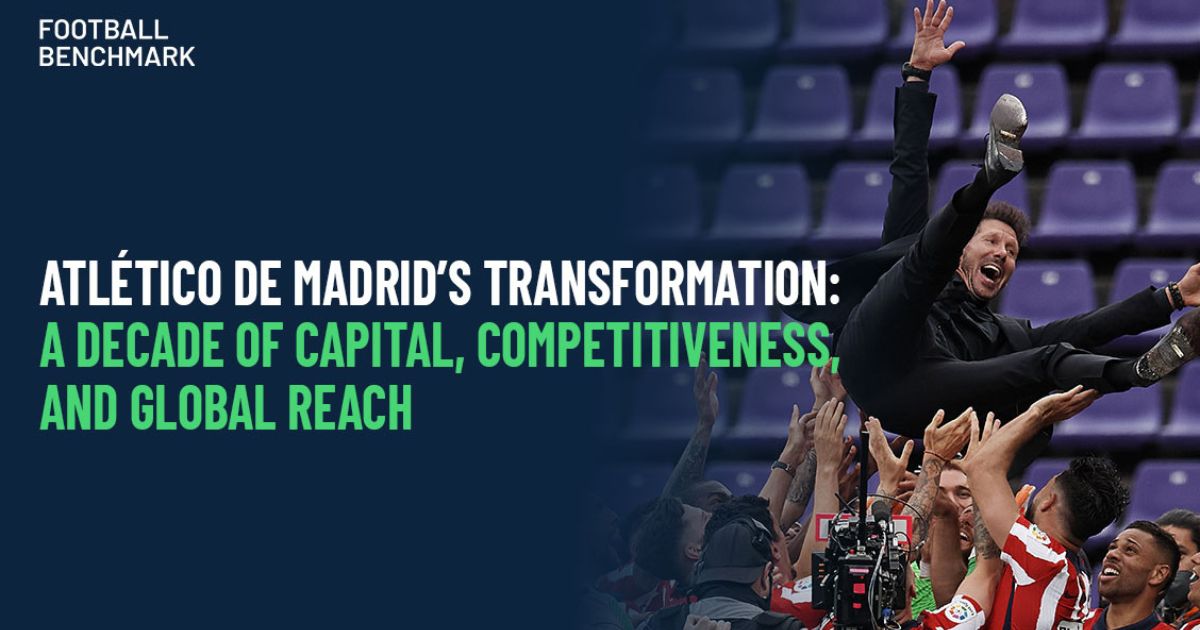
Atlético de Madrid’s transformation: A decade of capital, competitiveness, and global reach
Article by Yossi Segal & Márton Ferencz | Football Benchmark Over the past decade, Atlético de Madrid has redefined its position in European football. On the pitch, the team has become a regular fixture in the UEFA Champions League and has consistently challenged Spain’s two giants for domestic honours. Under Diego Simeone's stewardship, Atlético has reached two Champions League finals, won La Liga in 2014 and 2021, and lifted the UEFA Europa League and Super Cup, cementing its reputation on the

MAPPING SPORTING DIRECTORS: FOOTBALL DECISION-MAKER TRENDS ACROSS EUROPE’S “BIG FIVE” LEAGUES
Article written by Football Benchmark Sporting Directors have become increasingly visible in the discourse surrounding the summer transfer window, a period when their work moves into the spotlight. But their role extends far beyond player transfers. From squad building and recruitment to managing the academy pipeline and setting long-term sporting direction, Sporting Directors are now central to how clubs operate year-round. Seen as the strategic anchor of a club’s football department, they are expected to focus on long-term planning and sporting coherence. Yet
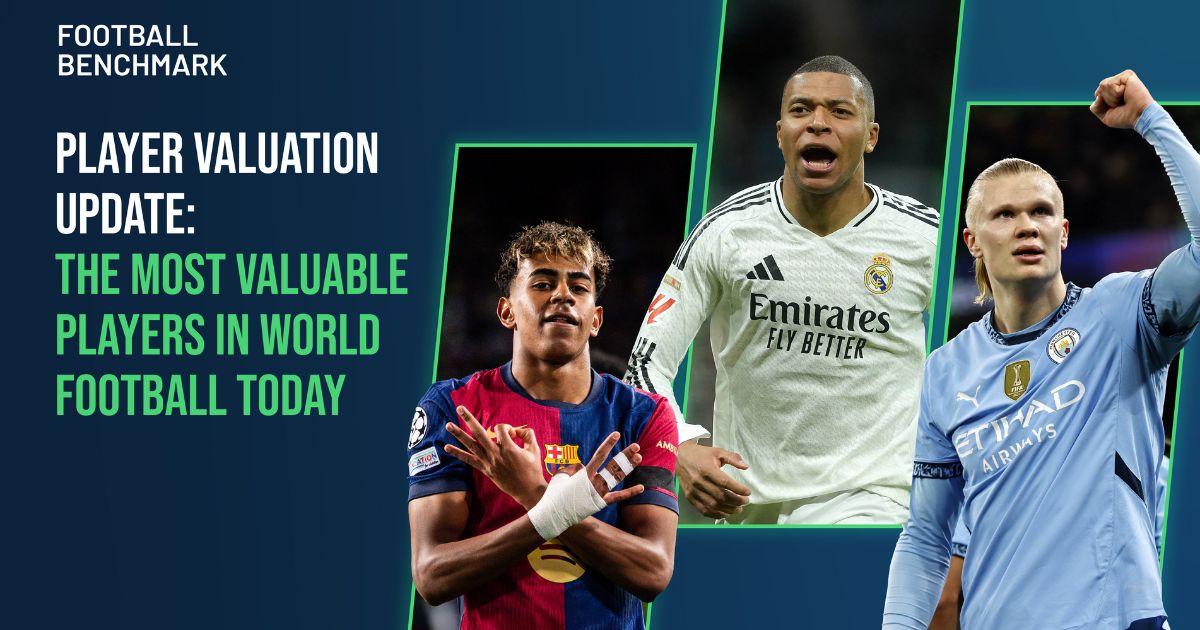
Player valuation update: The most valuable players in world football today
Analysis by Football Benchmark According to the latest update from Football Benchmark’s Player Valuation Platform, a record 21 players are now valued at over €100 million. Alongside this, the average value of the top 100 players has climbed since the Platform was launched (€77.6 million in 2019), hitting €87.2 million in June 2025. From Lamine Yamal’s remarkable rise to the top of the overall rankings to Hugo Ekitike’s valuation leap since February, the data reflects not just who’s most valuable, but how
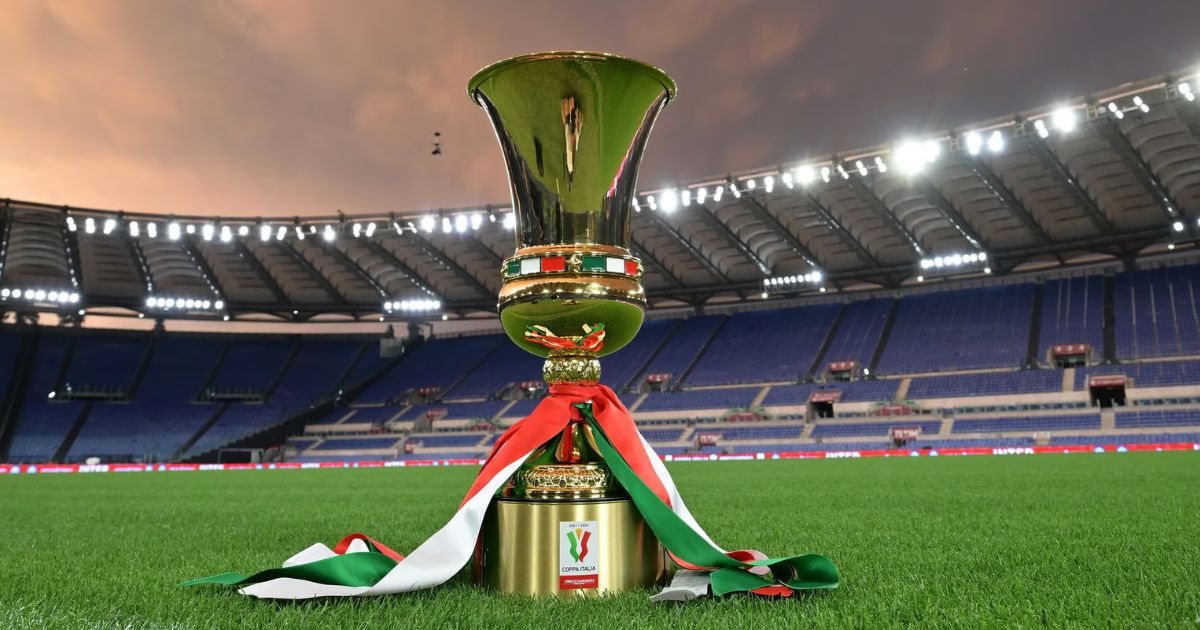
THE 2025 COPPA ITALIA FINAL HIGHLIGHTS SUSTAINABILITY BEST PRACTICE
After the inaugural edition of the “Road to Zero” project in 2024, Lega Serie A, Sport e Salute, Roma Capitale and Roma Servizi per la Mobilità, with the support of UEFA, continued their commitment to sustainability during the 2024/2025 Frecciarossa Coppa Italia Final. The final hosted AC Milan and Bologna FC at the Stadio Olimpico in Rome on the 14th May 2025 and saw the implementation of several initiatives in alignment with last years’ “Road to Zero” ESG (Environmental, Social and Governance) framework. The “Road to Zero” ESG framework was

International Sports Justice Under Attack: Opinions from the EU Court of Justice
Article written by Carlo Rombolà As we enter 2025, if anyone still believes that sport — in the broadest possible sense — is limited to athletic performance or match results, it is time for a wake-up call. Such a mindset risks overlooking key elements, foremost among them: sports justice. From the Sinner case in tennis to the Brescia case in Italy’s Serie B football league — to mention only the most recent examples — sports enthusiasts can no longer rest easy until the results achieved
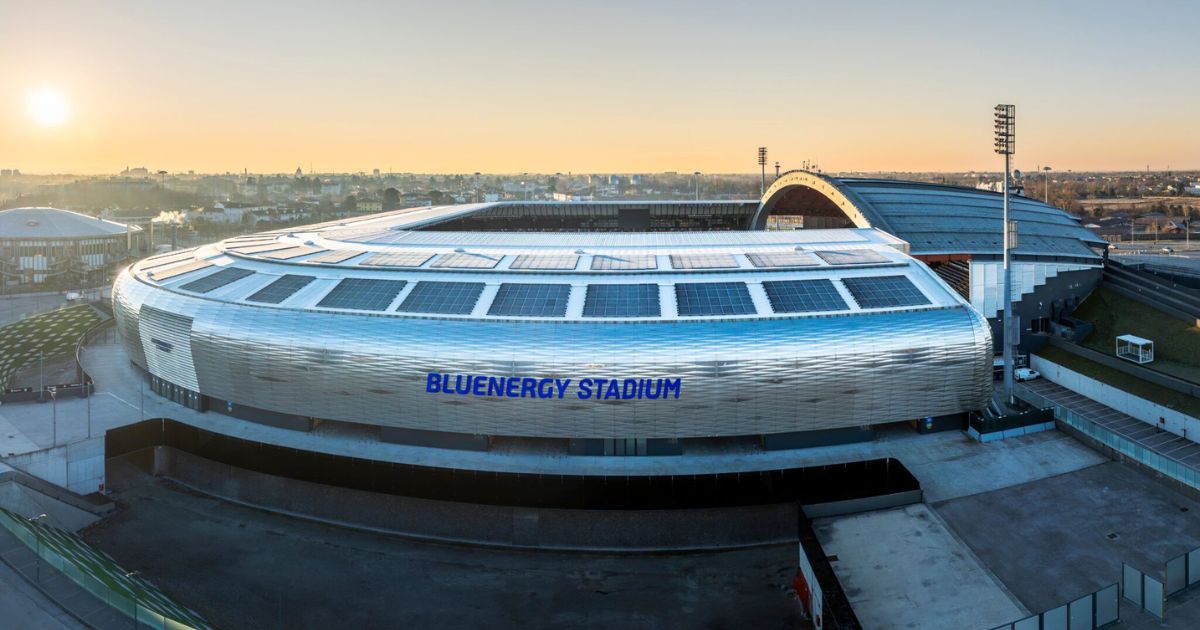
Bluenergy Stadium solar farm at the center of soccer’s first energy community
Press release published on the official website of theUdinese Calcio. An unprecedented sustainability and solidarity initiative comes to life around the 1.1 MWh/year photovoltaic park at Udine Stadium Udinese Calcio and Bluenergy Group's joint commitment to environmental and social sustainability takes an extraordinary new step today. As the two clubs announce the completion of work on the photovoltaic system housed on the roof of Bluenergy Stadium, a new project involving the Friuli Venezia Giulia region and society comes to life. THE ENERGY COMMUNITY "Energy

EA FC FUTURES joins Bundesliga Common Ground in creating more opportunities to play around the world
This article is available in its original and unabridged version on the official Bundesliga website. The Bundesliga and EA SPORTS have joined forces as part of EA SPORTS FC FUTURES initiative, making the most of the established Bundesliga Common Ground pitches to provide further benefit to local communities around the world. This partnership project aims to promote the revamp and continued utilisation of 4 community pitches located around the world. Starting with the sites in Brazil, Nigeria, Indonesia and Germany, each pitch

Football from a global perspective: strategies, challenges and opportunities of the new digital era
Football is undergoing an unprecedented transformation, extending into new markets and reaching fans around the world. In the SFS panel'Globalization of football: how football is expanding into new markets,' industry experts discussed the strategies, challenges and opportunities that are driving the globalization of the game. Speaking on stage, moderated by Didem Dilmen , Director Of Communications Comparisonator, were Carolina Tha, Country Manager ITA, ES, PT and CH SambaDigital, Lucas Bugter, Director of Business Development 433 and Nicole Pike,