



The panel “Are football infrastructures a real investment?” addressed a crucial question for the future of Italian football: do investments in stadiums and sports centers truly generate value? The answer, which emerged from the discussion among experts from Deloitte and representatives of virtuous clubs like Fiorentina, Cagliari, and Udinese, was unanimous: yes, but only if integrated into a 360-degree business model. Present on stage were: Alessandro Ferrari (Fiorentina), Stefano Melis (Cagliari), Luigi Capitanio (Deloitte), Franco Collavino (Udinese), and the panel was moderated by Carolina Zavanella of Gau Arena.
Training centers: investing in human capital
The focus began with training centers, which are true talent incubators. Ferrari illustrated the case of Viola Park, stating that “It takes an incredible owner and president. The costs of Viola Park have risen from 60 million to 123 million. Maintaining the facility means spending 7-8 million a year, 7 days a week.” He added that the structure is not only designed for the team: “The cutting-edge media center is useful for hosting diverse events with heterogeneous purposes.” This multifunctionality demonstrates how the investment, although costly, can generate constant value over time.
Urban regeneration: the Cagliari and Udinese models
Cagliari’s Unipol Domus has been defined as a benchmark for Italian stadiums. Melis pointed out how an initially temporary project became a driving force for urban regeneration in the Sant’Elia neighborhood. “We focus heavily on cross-cutting sustainability and innovation. The stadium is a reference point for the community, a form of urban stitching, and a driver for regeneration.” Resilience has been a key factor: Melis noted that without solid and continuous ownership, the project, hindered by the pandemic and changes in political leadership, would have been abandoned. They have now been playing in the temporary stadium for seven years, with the legislative process of the “stadium law” stalling projects due to shifts in regional and municipal political scenes.
Collavino highlighted the promotional impact of the Bluenergy Stadium, chosen by UEFA to host the European Super Cup. “UEFA chose us because of the growth the Bluenergy Stadium has had. Such a major sporting event, with over 20 million viewers and 25,000 people in the stadium, had enormous promotional and economic benefits for the territory, along with collateral initiatives promoted by the Friuli Region.”
The golden rule: from cost to community value
Capitanio of Deloitte summarized the metrics that attract investors: “The key metrics must be distinguished between the investor as the club owner and those who believe the investment goes beyond the invested value: investments that do not go from one to many, but from one to the entire population that revolves around the stadium. One of the fundamental drivers remains the legacy for the fanbase.”
Both in the case of Cagliari (public-private model) and Fiorentina (where the stadium “is not just the team’s, but the entire city’s”), the key is a community of purpose, based not only on money but also on the cultural and sporting heritage that will last forever. The goal for the future, as Collavino concluded, is not just to import European models, but to export the Italian model based on: thinking big, with multifunctional structures that respond to the service requests of the territory, and facilities operating 365 days a year. Strong, determined ownership with passion, heart, resilience, constancy, and concreteness, and the ability to understand the territory’s demands, are essential. One thing is certain: modern stadiums and sports centers are much more than simple arenas for football; they are engines of urban regeneration and true economic assets.
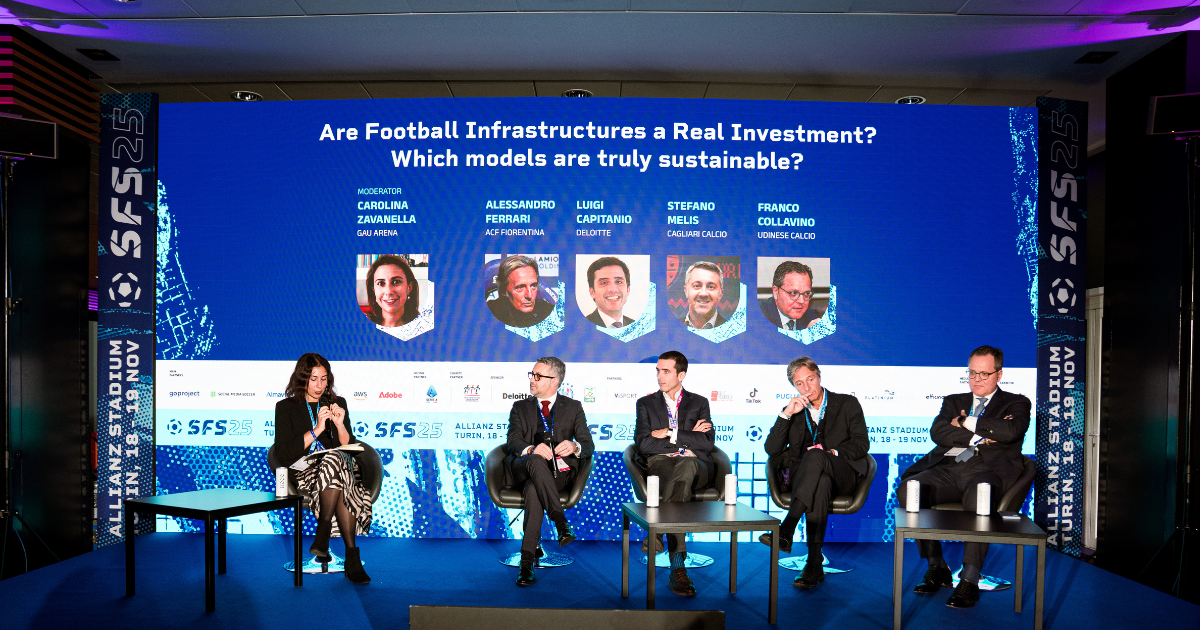
Are Football Infrastructures a Real Investment? Stadiums and Sports Centers: The Shift from Cost to Asset
The panel "Are football infrastructures a real investment?" addressed a crucial question for the future of Italian football: do investments in stadiums and sports centers truly generate value? The answer, which emerged from the discussion among experts from Deloitte and representatives of virtuous clubs like Fiorentina, Cagliari, and Udinese, was unanimous: yes, but only if integrated into a 360-degree business model. Present on stage were: Alessandro Ferrari (Fiorentina), Stefano Melis (Cagliari), Luigi Capitanio (Deloitte), Franco Collavino (Udinese), and the panel
Beyond the Pitch: Serie A is a Total Communication Platform. The Value Between Emotion and Data
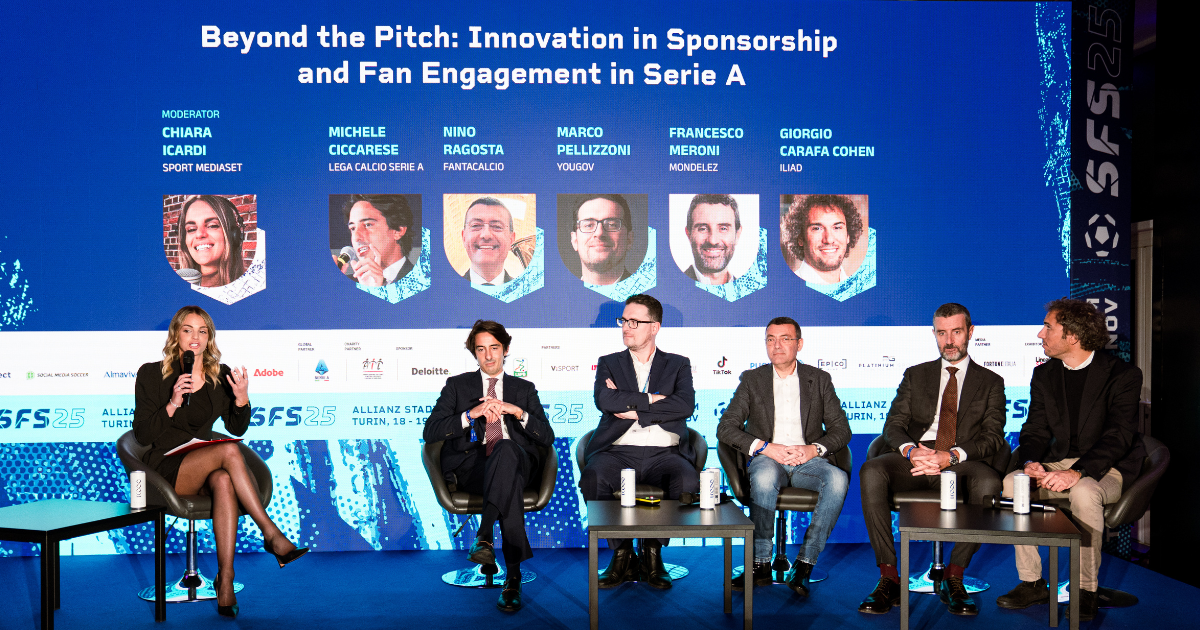
Innovation, engagement, and ROI measurement. These were the keywords of the panel “Beyond the Pitch: Innovation in Sponsorship,” moderated by Chiara Icardi (Sport Mediaset), which brought together industry experts to discuss how football sponsorship is evolving from a mere presence to a genuine communication strategy. On stage were: Michele Ciccarese (Lega Serie A), Nino Ragosta (Fantacalcio), Marco Pellizzoni (YouGov), Francesco Meroni (Mondelez), and Giorgio Cohen Carafa (Iliad). Serie A: from sporting event to digital platform Michele Ciccarese began by clearly defining the
Investing in Portuguese football: a prime spot for Multi-ClubOwnership?
Analysis by Football Benchmark 1. Portugal boasts a strong player development ecosystem, with elite academies consistently producing high-value talent that moves to Europe’s top leagues.2. The country’s historical and linguistic ties to some areas of South America and Africa provide a competitive edge in scouting and integrating emerging talent.3. Favourable regulations, including unrestricted recruitment of non-EU players, enhance Portugal’s appeal as a key market for international talent development.4. The relatively low acquisition costs of Portuguese clubs, coupled with expected revenue growth
The Diarra Case and Sports Justice: Football Between Courts and International Regulations
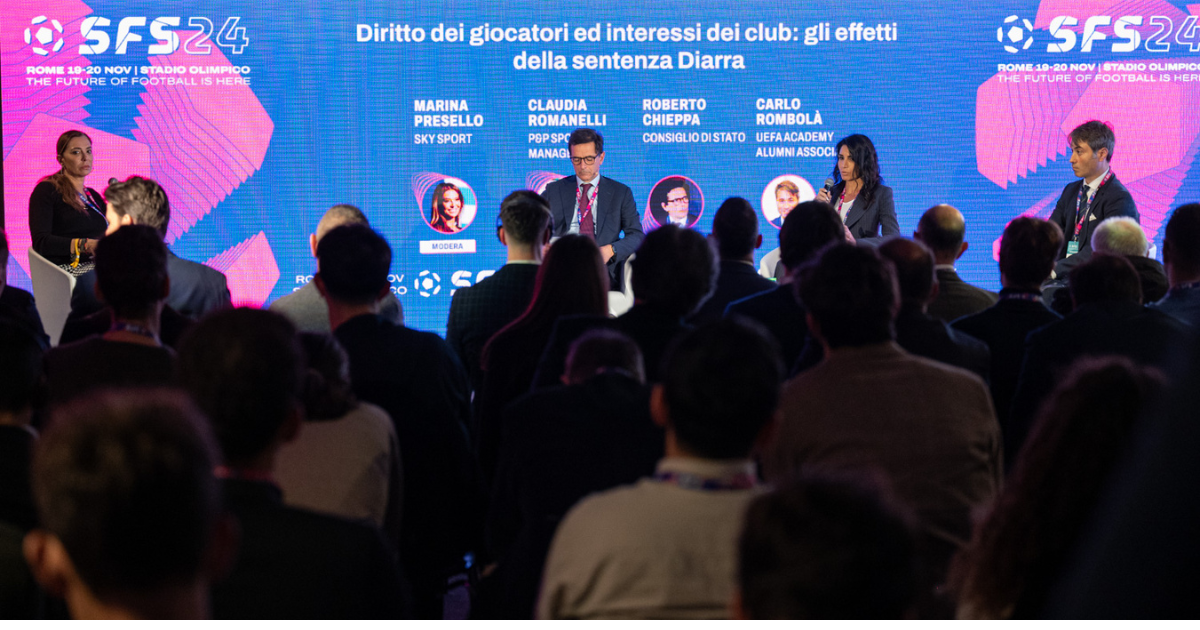
Can a court judgement change the rules of the game?The panel “Players’ rights and club interests: the effects of the Diarra ruling” shed light on one of the most complex cases in modern sports justice, sparking new reflections on the balance between sports law and EU law. Moderated by Sky Sport journalist Marina Presello at SFS24, the panel featured Claudia Romanelli (P&P Sport Management), Roberto Chieppa (President of Section at Consiglio di Stato), and Carlo Rombolà (UEFA Academy Alumni Association). Lassana
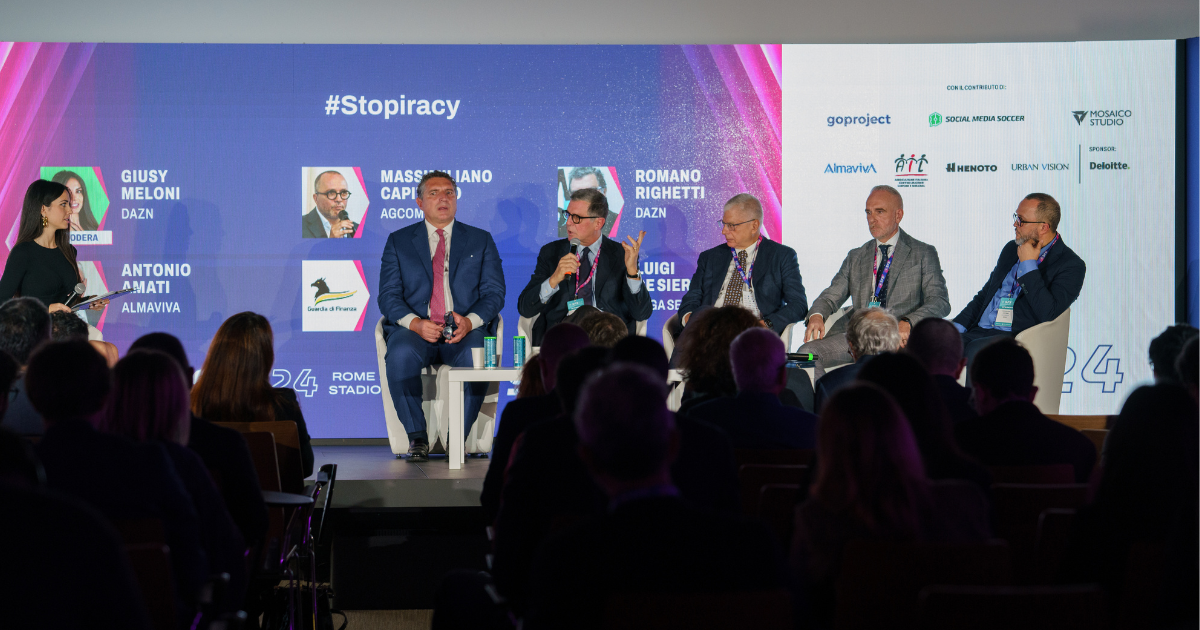
Stop Piracy: How the Piracy Shield Protects the Future of Football
Illegal streaming continues to threaten the economic sustainability of football and sports in general. During the ‘#Stopiracy‘ panel held at the Stadio Olimpico as part of the SFS event, moderated by DAZN journalist Giusy Meloni, experts and institutional representatives analyzed the challenges and solutions to tackle the phenomenon. Among the panel’s guests: Antonio Amati (IT General Manager at Almaviva), Gaetano Cutarelli (Colonel, Guardia di Finanza), Romano Righetti (General Counsel, DAZN Italia), Massimiliano Capitanio (Commissioner, AGCOM), and Luigi De Siervo (CEO,
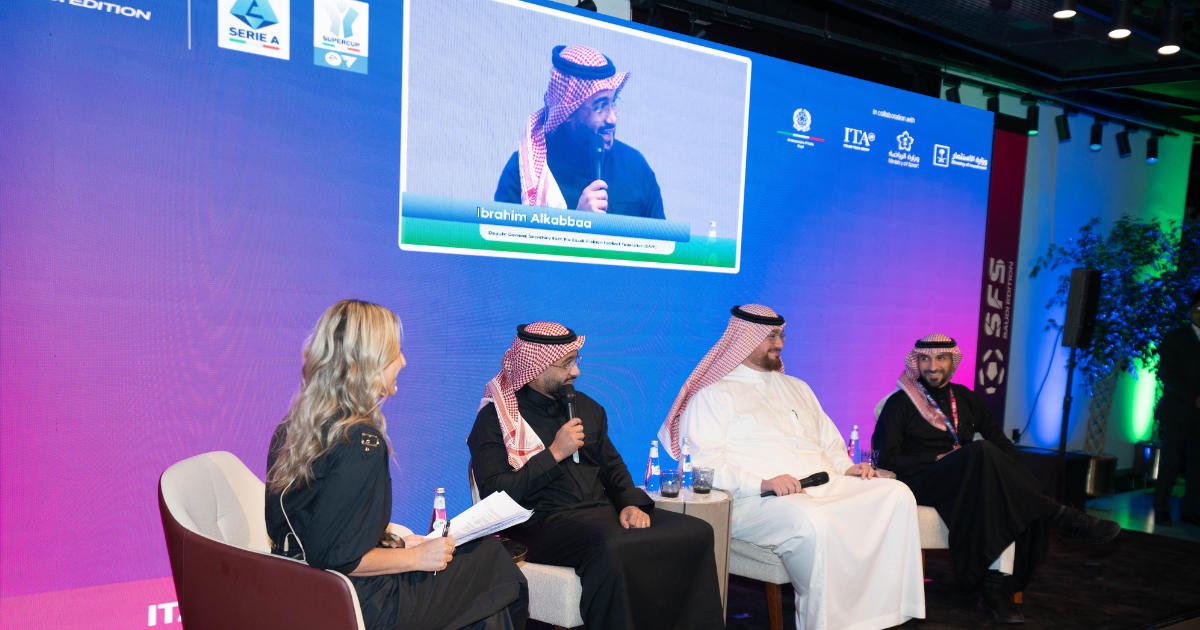
SFS Saudi Edition: Making the Arabian Peninsula an attractive sports platform and a global tourist destination
"Sport, and the tourism associated with it, is an integral part of Saudi Vision 2030. The ultimate goal is to make the Arabian Peninsula an attractive sports platform and a global tourism destination", stated the Deputy General Secretary of SAFF Ibrahim Alkabbaa during the session 'Sports Tourism and Major Events: Opportunity and Impact of Football Competitions' held as part of the SFS Saudi Edition. To discuss it with him, Laith Khayyat (Executive Director of Strategy and PMO – Mahd Sports Academy),
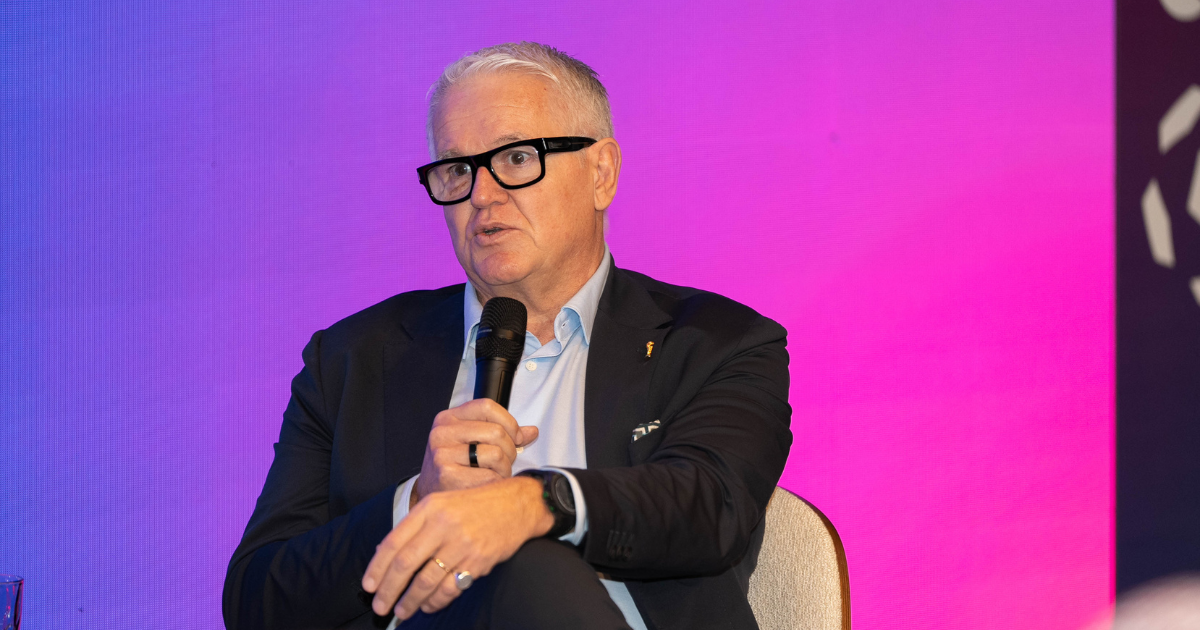
SFS Saudi edition: Football, Investments and new global visions
At the SFS Saudi Edition, within a framework of internationalization and enhancement of the Serie A product, globally renowned guests from the football industry participated. Carlo Baldocci, the Italian ambassador to Saudi Arabia, Ezio Maria Simonelli, the newly elected president of the Serie A League, and Abdulrahman Justaniah, Deputy Minister for Strategic Planning and Investments at the Saudi Ministry of Sports, opened the scheduled panels with institutional greetings addressed to the audience and those streaming the event on the Summit's
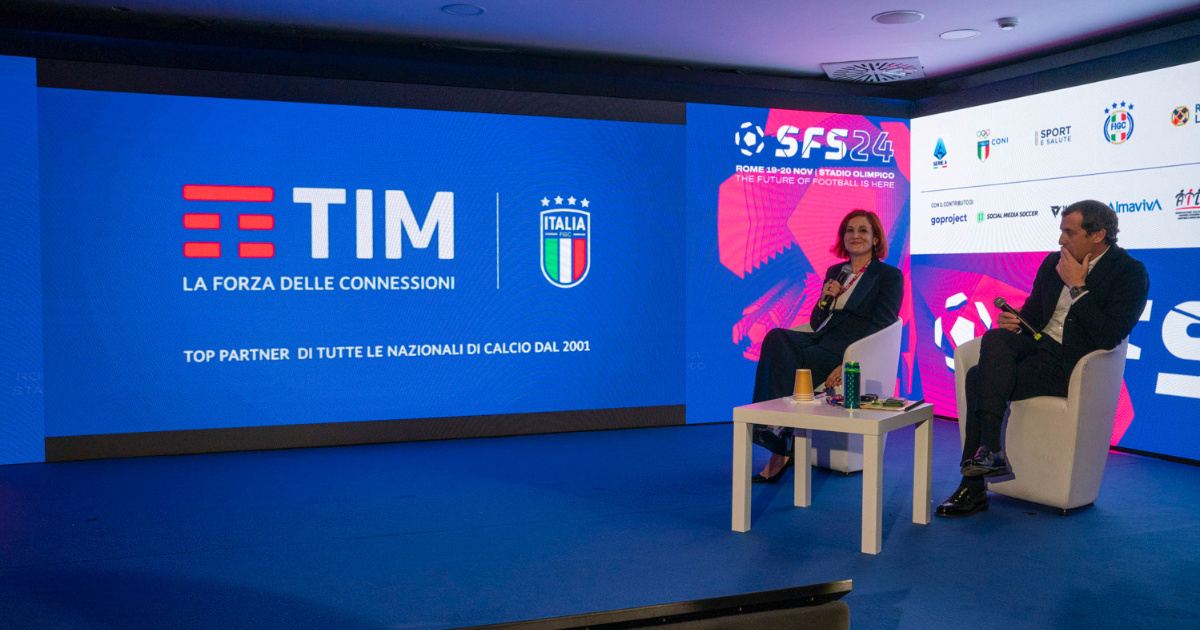
TIM and FIGC: 25 Years of Winning Connections in Sports
The partnership between TIM and FIGC is a long-standing one, soon to celebrate its 25th anniversary. A journey that began in 1999 between two similar organizations, both representing Italian identity and committed to values such as sports and solidarity. During a panel moderated by DAZN journalist Barbara Cirillo, Giovanni Valentini – Head of Revenue Area and Deputy General Secretary of FIGC – and Sandra Aitala – Head of Brand Strategy and Commercial Communication at TIM – reflected on the initiatives promoted

INFRONT PARTNER OF SFS23: 21-22 NOVEMBER THE 6th EDITION OF THE SOCIAL FOOTBALL SUMMIT
The partnership is renewed for the third year in a row with the naming of the Corporate Area and the launch of the Infront Sport Business Academy Rome, 10/26/2023 - The partnership has been renewed for the 2023 edition thanks to the naming of the Infront Corporate Area, the networking & hospitality area of the sixth edition of the Social Football Summit. The two-day event dedicated to the Football Industry returns on 21 and 22 November in the fascinating setting of

ON 21 AND 22 NOVEMBER, THE SIXTH SOCIAL FOOTBALL SUMMIT. LEGA SERIE A IS GLOBAL PARTNER OF SFS23.
Rome 25 October - In November, the Social Football Summit returns, two days dedicated to the Football Industry full of meetings and new developments in the splendid venue of the Stadio Olimpico. Through the contributions and participation of Institutions, Federations, Leagues, Clubs, Media and Top Brands, the Social Football Summit continues to be an international reference point of its kind on the issues of business, innovation, marketing and communication in Italy An important opportunity for the protagonists of football to